
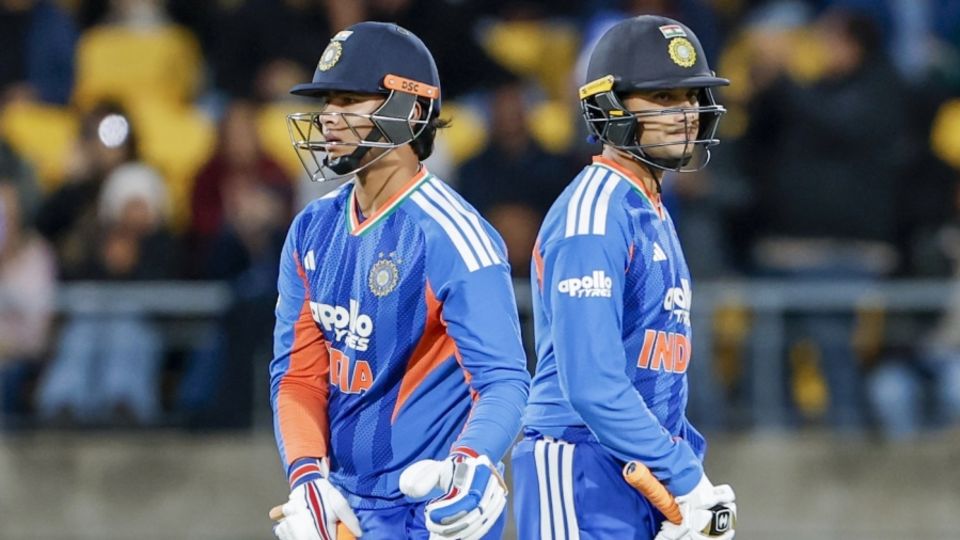



"I was like 'how!?'"
It was important that Abhishek Sharma and Vaibhav Sooryavanshi both got out in Wellington. They added 133 in 7.1 overs, bringing up the quickest team fifty and the second-quickest team hundred in T20Is. Abhishek went on to threaten his own personal best of 30 balls for a hundred - also the fastest among Full-Members - but eventually cruised to the landmark in 35.
It was important that Abhishek Sharma and Vaibhav Sooryavanshi both got out in Wellington. They added 133 in 7.1 overs, bringing up the quickest team fifty and the second-quickest team hundred in T20Is. Abhishek went on to threaten his own personal best of 30 balls for a hundred - also the fastest among Full-Members - but eventually cruised to the landmark in 35.
It was particularly important that the pair was finally dismissed so that Shreyas Iyer, India's No. 4 and T20I captain, could go in and face a few balls. It allowed him to experience the conditions for himself, and gave us an amazing sentence to remember this carnage by. "When Sanju [Samson] and I went to bat, the ball was seaming around," Iyer said after the match. "And I was like how?! How did they manage this?"
Recommended Read

That this deserves to be recognised as a separate sport. It shares equipment, grounds, pitch dimensions, officials and players with this thing called cricket, but it has its own fundamentals. It has taken about 20 years since this format was invented for teams to realise just how far they can push its boundaries, for there to be enough know-how to practise pushing those boundaries, and for there to be enough financial reward and recognition for its practitioners to specialise in doing so.
What finished 15 minutes before this started was close to what we know as cricket. The India bowlers knew they had limited agency in this format. The best they could do was formulate plans to make New Zealand's batters hit towards the bigger straight boundaries and not the short square ones, then try to execute those plans and be stoic about results.
The New Zealand batters, as they have been doing pretty much all year against India, tried to maximise "cricket". This was their ninth T20I against India this year, including the T20 World Cup final. They have won one and lost eight, with those defeats including a chase of 199 completed in 13.2 overs on Tuesday, a gunning down of 209 in 15.2 overs, a mauling of 154 in ten overs, and, of course, the 255 India piled up after being asked to bat first in the T20 World Cup final.
The difference between the two sides on most of these occasions has been that while New Zealand play something that resembles cricket, India play T20. New Zealand do it well, well enough to make the final of the T20 World Cup, but they also restrain themselves. Not intentionally. They possibly don't have the right combination of understanding of the format, and the quality and depth of hitting to transcend conditions and the quality of bowling.
Abhishek and Sooryavanshi, and to an extent Sanju Samson and Ishan Kishan, strive to flip the basic tenet of cricket: a bowler initiates the action and the batter reacts. They practically force the bowler to react to them. Any combination of the three brings together so many different ways of hitting boundaries that you can forget about a margin for error. Even perfection is often not respected. And the smaller the bullseye gets, the likelier you are to miss by a bigger margin.
In this match, for example, India bowled full to use the long straight boundaries, found some early seam movement, and New Zealand didn't have the range of hitting necessary to throw them off their plans. When India batted, Sooryavanshi and Abhishek hit perfectly acceptable lengths for a four and a six straightaway. Then they had the bowlers reacting to their hitting, which rarely works out for the fielding team.
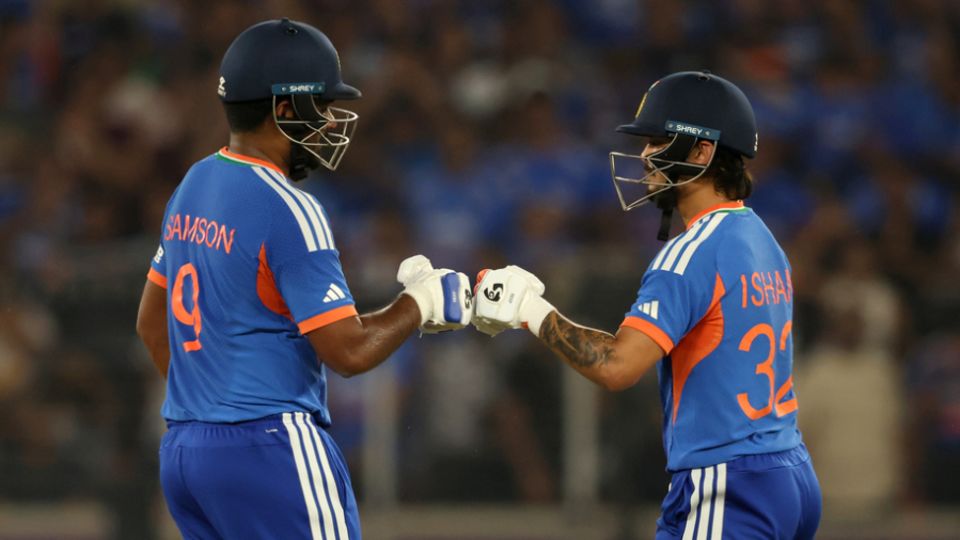
We run the risk of not appreciating how special this is simply because of how often the India batters are doing it. If the IPL weren't enough, this was India's 38th T20I this year, some of them played with jetlag after flights across the world. Abhishek alone has set the world record for the fastest Full-Member hundred and come close to breaking it. Samson has lived a lifetime's worth of memories in the last three matches of the T20 World Cup. Kishan forced Shubman Gill out of the same event and then played the innings of the tournament: a 77 off 40 in conditions where the rest of India and the entire Pakistan line-up dawdled at around a run a ball. That innings, too, already seems a distant memory.
Then there is Sooryavanshi, chomping at the bit, ready to step in whenever called upon and do what he did in Wellington. And there is a middle order, led by Tilak Varma who has never lost when he has stayed unbeaten in a T20 chase, that is gaining experience of finishing games when the top order doesn't come off.
There is no magic potion behind this. India have more people practising to play T20, thus more people in the squad equipped to play T20, and thus a higher probability of one of them coming off even though this is conventionally a high-risk approach. There will be defeats along the way, like in Ireland and England, but that is the price they are willing to pay for the kind of dominance this approach to hitting brings them.
Raise your hand if you had already forgotten most of these astonishing feats mentioned above. If everything has merged into one long highlight reel of unbelievable hitting that is no longer unbelievable because, hey, it is taking place every third night. If it doesn't evoke the same emotion as a Test century ground out in seven hours on a tough pitch. If you miss the agency that bowlers once had.
You are not alone in feeling that way. It is all right to feel that way.
It doesn't, however, take away from the hard work, the amount of practice, the level of fitness and the courage that go into getting so good at hitting. And then being able to do it in front of bigger crowds than other cricket gets.
Nor does it take away from the thrill of that moment, of having put together a life's work in just 30 balls or so. Or from the adrenaline that leaves batters as drained as a Test marathon. Or from the applause of those attending, acknowledging that they have been part of something special, no matter how frequently it happens.