
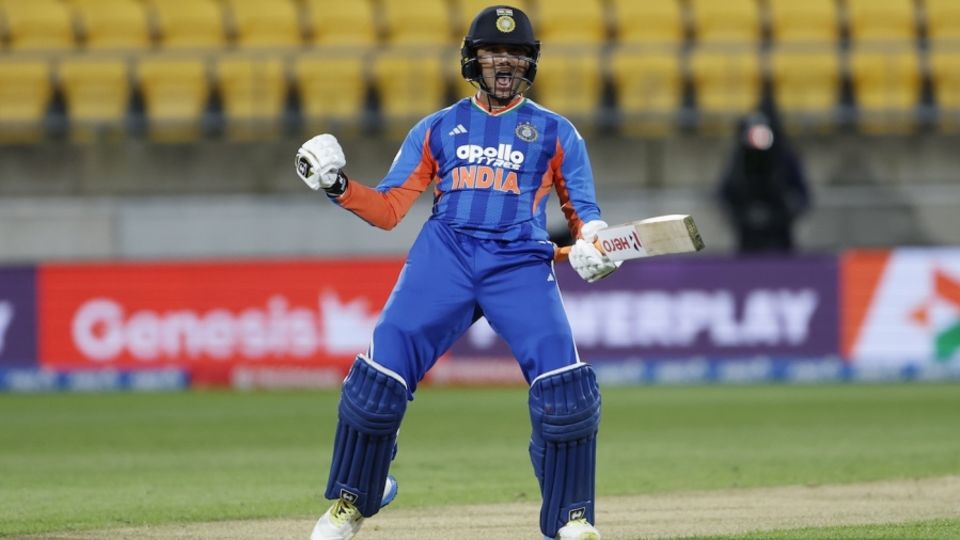



India 199 for 4 in 13.2 overs (Abhishek 113, Sooryavanshi 45, Jamieson 2-45) beat New Zealand 198 for 3 (Mitchell 89*, Allen 40) by six wickets
This sort of thing has happened before. Famously, Netherlands did it at the 2014 T20 World Cup, chasing down 190 against Ireland in 13.5 overs to qualify for the Super 10 stage. But that was a response to a specific demand, a team batting out of their skins to meet a net-run-rate target.
On Tuesday, when India chased down 199 in a mere 13.2 overs in Wellington, they did so as a matter of course. This is how they bat. This is how Abhishek Sharma bats in any T20 game. He rushed to his fifty in 15 balls, got to his fourth T20I hundred in 35 balls, and along the way performed an even more remarkable feat, upstaging Vaibhav Sooryavanshi in a 133-run opening stand that consumed just 7.1 overs. Abhishek and Sooryavanshi took India to a T20I record 118 for no loss in a powerplay where it didn't seem to matter what lines and lengths New Zealand bowled.
All that had mattered in the first half of this match, where India's fast bowlers had used the exaggeratedly oval dimensions of Hnry Stadium (long straight boundaries, short square boundaries) expertly to contain New Zealand, bowling full and straight and generating reverse swing.
None of it mattered when Abhishek and Sooryavanshi batted. They tore up the notion that bowlers begin every play in cricket. When these two bat, the thoughts of what they could do, where they could move in the crease, and where they could potentially hit the ball have already influenced the bowler's choice of delivery. No choice worked on this day, and India ran away to victory in absurdly quick time, sealing a series win with two games to go.
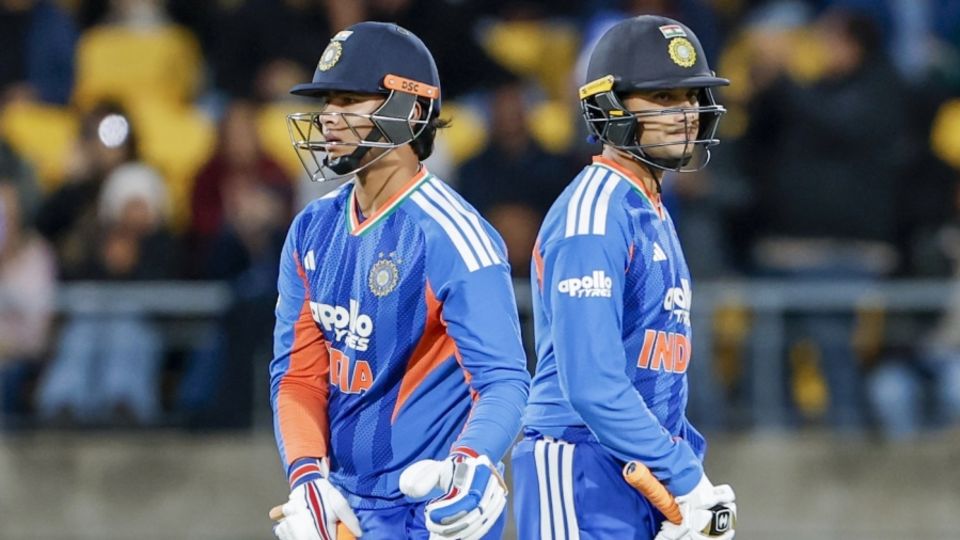
Abhishek and Sooryavanshi reach absurd heights
Jacob Duffy bowled the first over of India's innings. He bowled a front-foot no-ball. He bowled a bouncer that was wided for height and beat the leaping keeper and ran away to the boundary. Sooryavanshi and Abhishek carved him over point once apiece for eye-catching sixes. Twenty-six runs came off that over. It was India's fourth 20-plus over of the series. New Zealand have none.
India continued to reiterate the gap between the two teams' batting ceilings. By the time this match ended, India led New Zealand 7-0 for 20-plus overs in this series.
This was partly down to the elite level of boundary-hitting skill Abhishek, Sooryavanshi and some of their colleagues possess. Finn Allen apart, New Zealand lack batters who can match them. But it was also partly down to the intent India showed - not just aggressive in a reactive way, but with the ways the batters set themselves up at the crease and their preparedness to target under-manned areas of the field - particularly in the powerplay - no matter what line or length they were facing. At this ground in particular, given the short square boundaries on either side, both batters repeatedly made room to carve and flay the ball square on the off side, or whip and pull over square leg and midwicket when the bowlers followed them.
India reached their fifty in just 2.2 overs - a joint-record for T20Is where ball-by-ball data is available - and brought up their hundred in exactly five overs. From 9.95 at the start of their chase, their required rate plummeted to 5.78 at the end of the powerplay.
Thereafter, it was just a question of how quickly Abhishek, the dominant partner in this stand, could get to his hundred, and how quickly India could finish the game. There was a bit of a stutter at the end, with Shreyas Iyer and Sanju Samson falling when India were just one hit away, but they still won with 40 balls to spare.
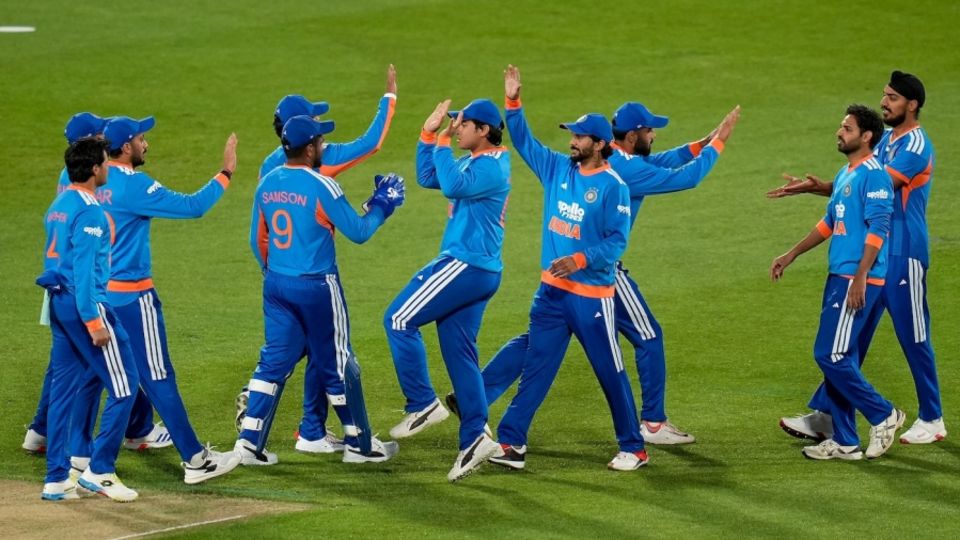
India go full with telling effect
After two games in Christchurch, it took India a little while to adjust to the dimensions of this ground. At Hagley Oval, with its vast square boundaries, it had been more advisable to err on the short side. India's fast bowlers had achieved an economy rate of 10.03 while bowling the fuller lengths (full-toss, yorker, full and good) and at 8.92 while bowling the shorter lengths (short of good and short), according to Cricinfo's ball-by-ball data.
Hnry Stadium called for a very different plan, and it took India a little while to adjust. By the end of the eighth over, New Zealand were 88 for 1, with Allen and Daryl Mitchell having hit eight sixes between them, the bulk of them with pulls and flat-bat swats when the bowling had been on the shorter side.
Nitish Kumar Reddy, whose bowling has been one of India's major gains of this tour so far, then showed how to do it, coming on in the ninth over and dismissing Allen for 40 with a full, straight ball that he couldn't generate enough power against to clear an 80m-plus straight boundary.
The other seamers quickly followed Reddy's lead, with a bit of reverse-swing coming into the mix, and India began to control New Zealand's scoring. Mitchell struggled after reaching his half-century in 26 balls. He scored just 35 off the last 26 balls of his innings, finishing unbeaten on 89 off 52. Runs weren't hard to come by just at his end; Bevon Jacobs put on an unbroken 75 off 48 with Mitchell for the fourth wicket, and he finished unbeaten on 39 off 23.