
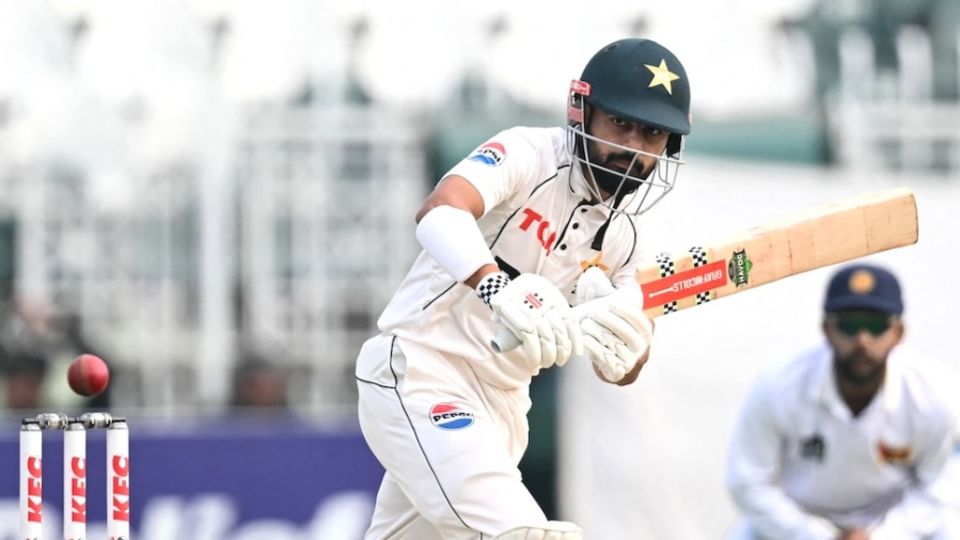


For much of day five, Saud Shakeel was ruled by discipline. The Rawalpindi track was the kind on which the old-school Test-match virtues reigned. Pitch the ball in the channel outside off stump with the seam pointed out towards the slips, ideally six times in an over. Leave the balls out wide, defend the good-length deliveries on off stump, and whatever you do, don't push away from the body or follow the ball with your hands.
Most of the dismissals in the match came from outside edges gobbled up behind the stumps. The skies were slate grey. The pitch barely changed. This felt like Test cricket in a uniform. And Shakeel batted accordingly for most of his second innings. He faced 210 balls but ventured only seven boundaries. He batted out five maidens by himself. Playing within yourself. Backing yourself to outlast your opponent both mentally and physically. Grit. Determination. Control. Many batting careers in Test cricket's history have been built on this stuff.
Shakeel happens to be in a building phase of his career. Although he is Pakistan's most prolific Test batter since the start of 2024, he nevertheless still has to make a case for himself, having almost been caught up in the post-Lord's cull, as Danyal Rasool notes here.
Recommended Read



But of course no one has been killing it lately, so all incumbents in the Pakistan side are necessarily serious works in progress. Babar Azam has had a good 2026, but hasn't quite clambered out of the hole he'd been wallowing in. Salman Ali Agha's charms are obvious, but his Test batting average sits in the mid-30s. Pakistan's lower order and tail are notably brittle, but in this series, the selectors have also stacked the top order with either rank debutants or others in the infancy of their Test careers.
Ideally, in the consolidation phase of your career, you have batters in the line-up who are reliable run machines. Younis Khan and Misbah-ul-Haq used to give such shelter to young Pakistan batters once. The likes of Azar Ali and Asad Shafique built much of their careers in that shade. Before Younis and Misbah, there was also Mohammad Yousuf and Inzamam-ul-Haq, both broad, flowering canopies beneath which younger trees could take root and prosper.
In this Pakistan side, Shakeel is among those who must provide structure and substance, though it has been less than four years since his debut, and though he has played fewer than 30 Tests. He's not an infant himself, of course, at age 31, and with a substantial domestic body of work on his record. But in this Pakistan batting group, he is required to assume substantial responsibility, even as he is trying to build out his own career.
In this match at least, he was the boulder around whom Pakistan built their innings. In the first dig, he had partnerships worth 68 with Mohammad Taha, 96 with Ghazi Ghori, and 44 with Arafat Minhas. Each of those partners was playing either their first or second Test.
On day five, Shakeel put on 92 with Ghori, the pair batting 26.3 overs together, before 44 off 10.5 overs alongside Minhas. In both those stands, he scored more runs, claimed more of the strike, and helped create a batting environment in which less-experienced cricketers could contribute to the rearguard. You don't generally have to bat to save a Test in a third innings in which your team has only given up a 12-run lead. But Pakistan cricket has nevertheless contrived the circumstances in which this innings was a serious test for Shakeel.
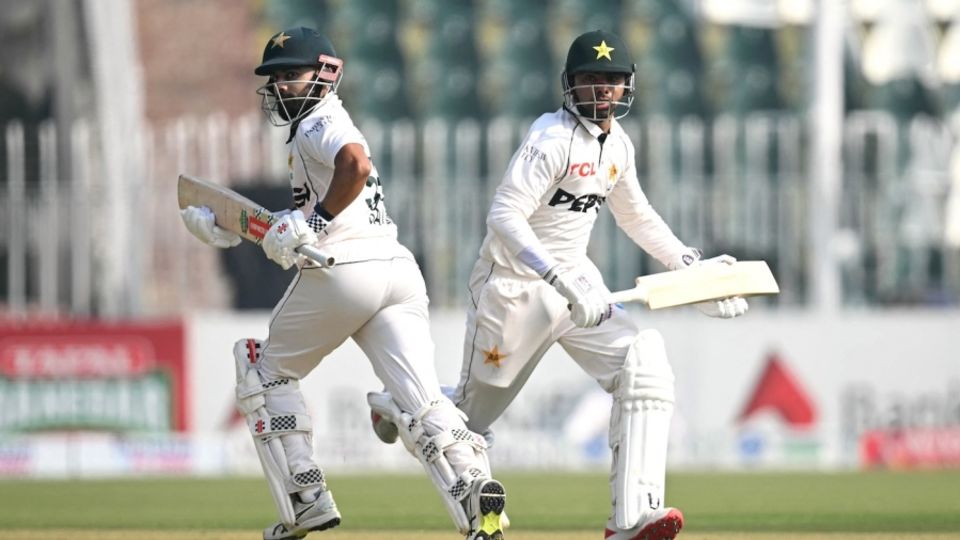
If there was a little uncharacteristic hurry from Shakeel towards the end of day's play, that only came when the outcome was already secure. He ran a risky two in the 90s; then, having played only rationally-defensible shots all of Friday, flashed at two Lahiru Kumara deliveries, the second of which took out his stumps. He was on 97, having been out on 93 in the first innings, having been out on 97 at Lord's of all places, in August. A consolidation phase of your career would really be a handy time to have had your name embossed in gold lettering in the most vaunted pavilion in the game.
Coach Mike Hesson is trying to be happy for Shakeel. "It's a nice problem to have," Hesson told the broadcaster after play. "If, as a batsman, your problem is getting out in the 90s, a lot of batsmen would like to have that problem."
Hesson is clearly trying to back his batter here, but his use of the word "problem" to describe Shakeel's plight is accurate. While, say, scores of 101, 117 and 114 in his last six innings read as scores he can take rest in, three scores in the 90s do not provide anywhere near that level of security, particularly in a team environment that appears to be in such flux.
Shakeel, though, is expanding his range. His first hundred against Sri Lanka was his 208 not out in Galle, where he had primarily had to tame spin in one of the most notorious spinners' venues in the game. Here, his match tally of 190 runs came against a spinner-less attack, at least among their frontline bowlers.
He doesn't have the benefit of growing his game in the shadow of bona fide greats, but he is still growing it. In this match at least, Shakeel provided the shelter that in previous eras of Pakistan's Test cricket, he himself would have been getting.