
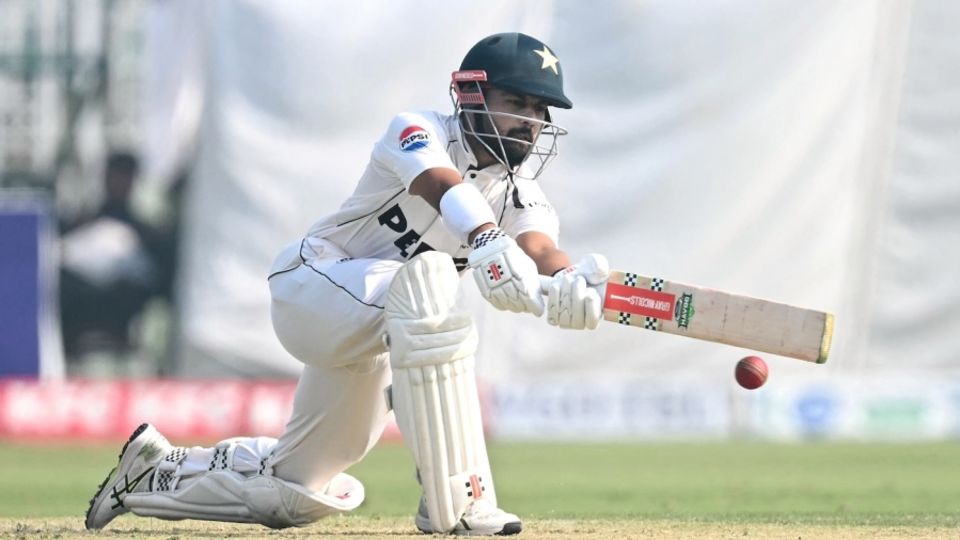


Pakistan take all sorts of factors into consideration when curating for a home Test, but the comfort of Saud Shakeel does not appear to be one of them. When he ascended from the gritty world of domestic cricket in Karachi in 2022, it quickly became clear those slow, low, spin conditions of his home town were tailor-made for his strengths.
Pakistan have not hosted a single Test there in four years, last playing there a month after Shakeel's Test debut. They had away series in Australia, South Africa and England over the last two-and-a-half years, venues designed to amplify his flaws; he ended up playing all eight of those Tests, by and large finding it tough going. Never mind: at least he had this home series against Sri Lanka to get his run-scoring rhythm back on track. Pakistan had, after all, begun preparing sharply turning wickets at home, where few could hold their own as effectively as Shakeel.
So Pakistan prepared a green, bouncy wicket in Rawalpindi. Spin was deemed so inconsequential that neither side considered playing a spinner worth their while.
Recommended Read


In Pakistan, as in most countries, pitches are usually prepared with bowlers in mind, either one's own or the opposition's. Pakistan's dramatic pivot mid-series to raked, fan-dried strips two years ago against England stemmed as much from England's paucity of spin options as it did Sajid Khan and Noman Ali's familiarity with those surfaces. The following couple of seasons saw them face sides with bowling attacks of a vaguely similar profile to England's, continuing to render that strategy effective.
The return of a grassy, bouncy wicket for this Test is almost certainly a nod to Sri Lanka's formidable ability to conjure up quality spin options, and fear of the devastation they would wreak on those surfaces. What that surface might mean for their best Test batter is unlikely to have been given so much as a passing thought.
Early on today, with the game evenly poised after Pakistan lost wickets late on the first evening, Shakeel found himself in a classic no-win situation. He favours careful, cautious accumulation, and is very good at it, but Pakistan's brittle lower order of late left him on a tightrope. He would have to score swiftly to pull far enough ahead of Sri Lanka before the inevitable collapse, while not giving away his own wicket, which would trigger that collapse. You could scarcely design a science experiment to cause him more discomfort.
But Shakeel has learned to get comfortable with feeling uncomfortable. With hindsight, it's clear he came uncomfortably close to losing his place in Pakistan's Test squad altogether after the famous post-Lord's purge, when Pakistan sent back seven players mid-tour the day following the defeat. Until the final innings before that reshuffle, Shakeel's had scored 5, 14, and 16 in three innings. Players who performed better than that were sent packing; it is hard to imagine he wouldn't have joined them on the plan if not for his doomed heroics in the final innings at Lord's.
That innings had captured, in real-match conditions on live TV, the moment when Shakeel appeared to step, once and for all, out of his comfort zone. After hanging around gamely as Pakistan tried to gun down an improbably fourth innings target, he watched his teammates fall by the wayside meekly once more as he edged towards three figures and an immortal spot on the Lord's Honours Board. In the first innings, Pakistan had lost their last five wickets for six runs. When the sixth wicket fell now, he knew the end was nigh.
Shakeel, who famously struggles against the short delivery, rocked his diminutive, 168cm frame back and lashed at Josh Tongue's bouncer, fired in at over 90mph, nailing it into the square leg stands. The situation resembled a Fear Factor studio when England revealed their cards by placing three fielders in that area as catchers. But Shakeel sent two more precisely there way to get himself up to 97. Like a man liberated, he lost even the fear of falling short of milestones, eventually picking out one of those fielders, walking away in defeat but potentially saving his career at the same time he conquered his fear.
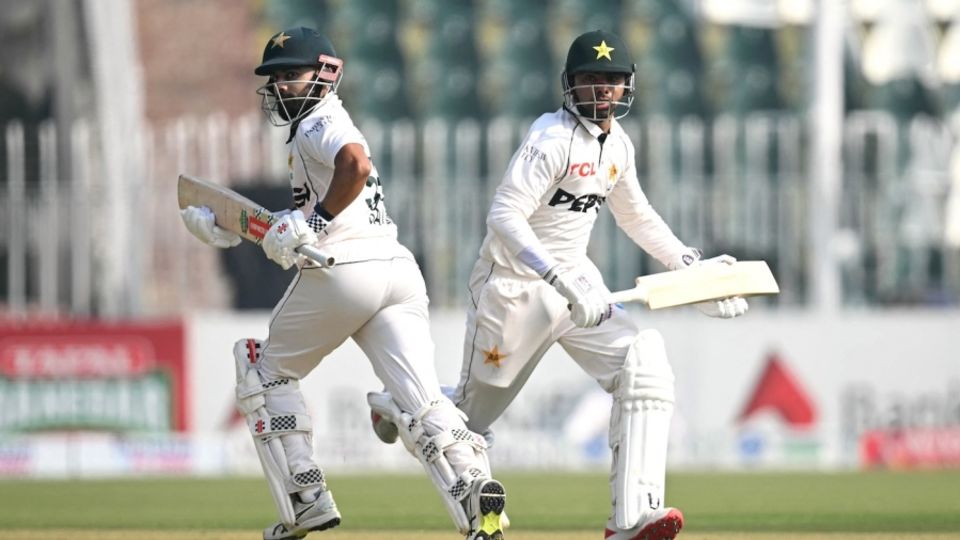
In Pindi, with his stature in the side much less questionable now, there was no tipping Shakeel off that tightrope. He allowed Ghazi Ghori, and later Arafat Minhas to keep up the runscoring, but held up his own end as a bulwark against the collapse. He had the ability, as he revealed in August, to take pace on if necessary, but Pakistan required a rudder, and for the first session, there was no moving him, even as the conditions became more challenging.
"We started quickly early on, we were going at nearly a run a ball," Shakeel said. "I think the pitch began to get more difficult for batting later on and seam movement came into the game. If we had attacked then and lost a wicket, we wouldn't even have been able to get the total we got. At the end Arafat chipped in with a very good 50, and we made up for being a little slow later on in the day. The days are getting shorter and so fewer overs are able to be bowled, so that was definitely in our mind."
The absence of fear, however, does not mean reality seizes to exist. Seven runs shy of a hundred, Shakeel finally decided to take the short ball on. Asitha Fernando had tried to target his body but drifted down leg, and Shakeel chased it with a hook in pursuit of an easy boundary. He ended up getting a nick; once more, Shakeel had fallen attacking the short ball, and once more, it had denied him three figures.
"It's disappointing not to reach your milestone, but there was no plan to play aggressively just because I was nearing a hundred," he said. "That ball reared up quickly and I was late on the shot, and that led to my dismissal."
This situation, as he indicated, was nothing like the one he faced in England. They had perhaps just one thing in common: Shakeel didn't end up getting what he wanted. But, as has always been expected of him, Shakeel is learning to get comfortable with that, too.