
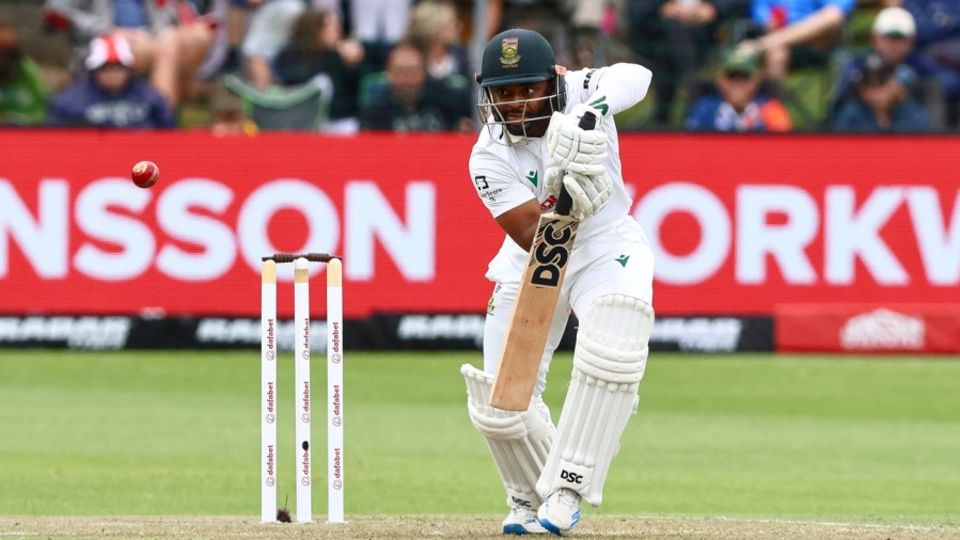



There was something wonderfully reassuring about Temba Bavuma's explanation after his magnificent 179 against Australia at St George's Park. At a time when batting seems more complicated than ever, here was one of the finest Test innings in recent South African memory drawing on an idea as old as the game itself: let the ball come to you and play it close to the body.
Bavuma spoke of studying Sachin Tendulkar, particularly his ability to play the ball late and close to his body. The remark took me back to players I had admired, some I had played against, and a conversation with a former Indian cricketer that has stayed with me for years. Their methods were often quite different, but their understanding of batting had much in common.
I watched Tendulkar from first slip for ten Test matches. What struck me was how little he seemed to do. His sideways position was beautifully balanced, his head still and his footwork so precise that he seldom needed a second adjustment. Even against Allan Donald at his quickest and best, he never looked hurried.
Recommended Read


We tend to explain such mastery by saying a batter sees the ball earlier or simply has more time. I have probably used those expressions myself, but I'm not convinced they tell us what's really happening. Exceptional talent matters, of course, but I believe there is a more practical explanation for that extra bit of time they have when playing their strokes.
Former Australian player and coach Bob Simpson put it neatly: move late, move quickly, and move once. To my mind, those words come remarkably close to explaining Tendulkar's batting. A batter who commits too early can find himself correcting his first movement because the ball is shorter, fuller, or moving differently from what he expected. Suddenly his head, feet and hands are trying to recover. I know from experience how you can be left playing from your crease, feeling for the ball and left off balance.
Wait long enough to gather the information, then respond decisively, and there is less to put right. Simpson's advice, I believe, explains the illusion that some players have more time than others. It may have less to do with superior eyesight or reaction speed than with the ability to not waste the time available. In this regard let's be reminded that even Sir Donald Bradman's reaction time, when tested, was shown to be ordinary.
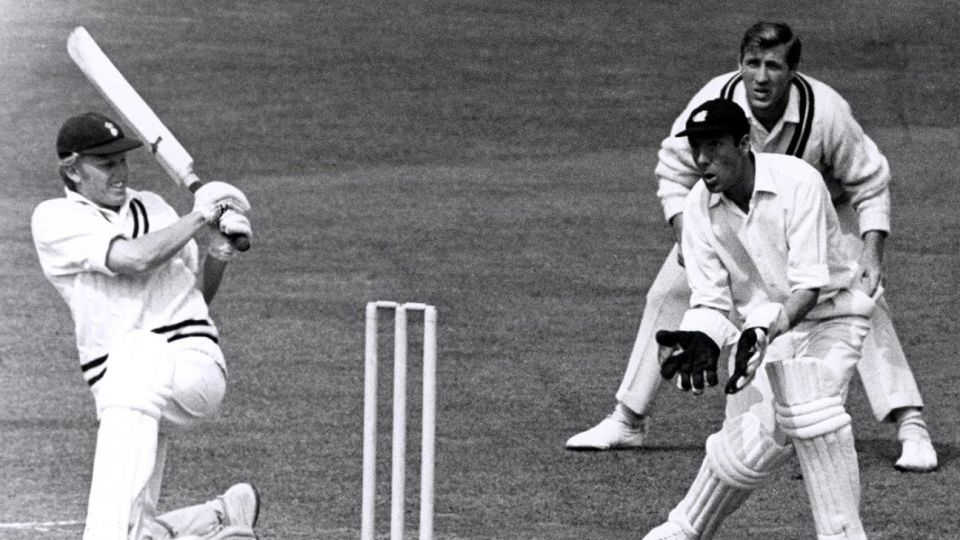
Barry Richards is another batter associated, perhaps more than anyone else, with having had time. I have watched as much footage of him as I could find, often concentrating on his feet rather than his strokes. His movements were late, precise and seldom repeated, yet he invariably appeared to be in the right position. There was no scrambling and scarcely a hint of being hurried. Watching him, I see Simpson's advice brought to life.
None of this is possible without watching the ball intently - probably the first instruction every young cricketer hears, and one of the least thought of when struggling for runs. Two of the finest watchers I encountered were Steve Waugh and Graeme Pollock, the latter quite simply the finest batter I have played with or against.
Pollock is a fascinating case because there is little about his technique I would teach a child. His stance was unusually wide, his back foot never moved in all his strokemaking, and his grip had a weak top hand and a strong bottom hand. Watching him bat was like seeing someone thread the finest cotton through the smallest imaginable eye of a needle - his concentration was that intense. I am convinced that's why he seemed able to make the tiniest adjustment at the last moment. It seemed as if he only committed to the shot once the ball had left the pitch.
Waugh's batting could look awkward and at times unattractive but he played it as close to his body. I can still see him defending on the front foot as if he was trying to smell the ball, his head was so over the ball. Where Pollock could make batting look beautiful, Waugh could make it a contest of wills. Both gave the ball an intensity of attention that I have not seen matched.
This thought takes me to a conversation I once had with Pranab Roy, who played two Tests for India. His father was the great Pankaj Roy, who played 43 Tests. I asked Pranab what he remembered of his father's advice.
His answer, again, was uncomplicated. Let the ball come to you, his father told him, and play it close to your body, even more so when advancing down the wicket. I have never forgotten it, not least because it was the accumulated experience of a fine international batter passed directly to his son in a few ordinary words, but Pankaj Roy understood that the feet serve the stroke.
I do believe shorter batters like Bradman, Tendulkar and Bavuma may look naturally compact. That's why Bavuma's acknowledgement interested me. He had watched Tendulkar, recognised something worth learning and made it relevant to his own game. This is how cricketing knowledge travels: through fathers, coaches, conversations, and the act of watching masters at work.
I learned an enormous amount during my career by observing other batters and asking myself why certain things seemed to come so easily to them, and that's why Bavuma's passing remark was a reminder of a great inheritance, which we often ignore at our own detriment. Cricket has developed extraordinary ways of analysing performance, but some of its finest knowledge is acquired through years of observation, experience, and the willingness of one generation to share what it has learned with the next.
We have spent generations admiring great batters for the time they appear to have and the extraordinary strokes they produce. Yet I suspect much of that brilliance can be explained by Simpson's advice - the ability to wait, respond decisively, and make one movement count.
The genius lies not in possessing more time than everyone else, but in knowing precisely how to use it.