
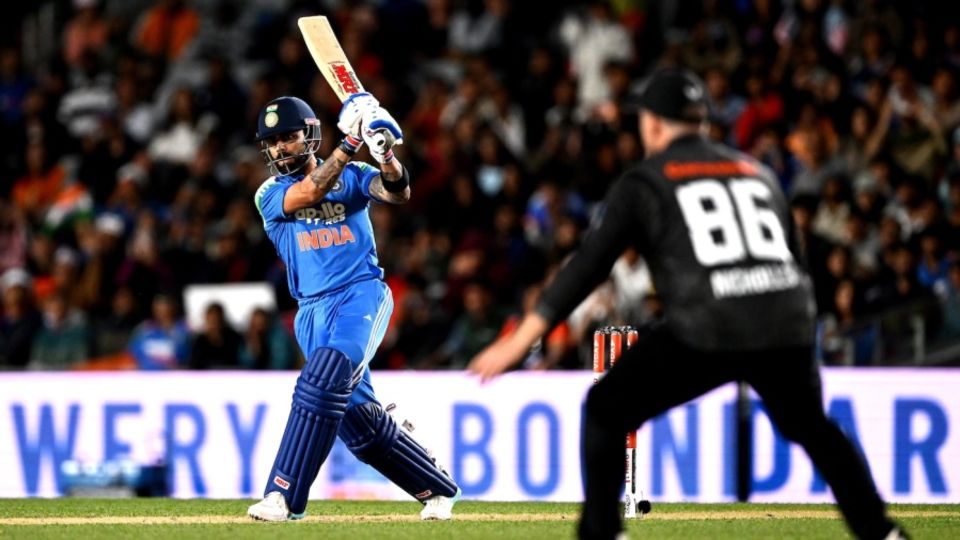



What is good batting? What is good batting on a tricky surface?
Such questions may have occupied your mind when a fine, swirling Auckland drizzle forced the players off the field 65 balls into India's chase of 186 against New Zealand on Wednesday night. Shubman Gill and Virat Kohli had put on 53 for the second wicket by then, and each was offering a different, and equally compelling answer to that question.
Gill had faced 32 balls and been in control of all but one of them. He was letting the ball come to him, meeting it right under his eye, and never letting his hands stray away from his body.
Kohli had played 10 false shots in 27 balls. On one of the bounciest one-day pitches in the world, and one with considerable seam movement as well, he was constantly looking to drive on the up, against lengths few others would ever try to hit down the ground even on the most placid surfaces.
The control numbers told one story. The scorecard told another. Gill was batting on 17 off 32 balls, and Kohli on 29 off 27.

And everyone watching this game was putting together, in their conscious and unconscious minds, the same story to tell their friends, relatives, colleagues, casual acquaintances and random passers-by the next day and 30 years later. "I watched Virat Kohli bat at Eden Park on November 4, 2026."
And this was before he had played the other, more jaw-dropping half of his innings. Kohli had, however, played a shot for the ages minutes before the rain arrived, punching a good-length ball from Blair Tickner on the up, piercing the narrowest of gaps between short extra-cover and mid-off, stationed wide and well inside the 30-yard circle. It's a hard enough shot to play even without accounting for the bounce Kohli was having to negotiate.
You only needed to watch everyone else bat here to know how much of a trampoline this pitch was. Four New Zealand batters had been out mis-controlling the pull. Gill, one of the best pullers going around, miscued one after play resumed, with extra bounce causing his bat face to turn and point up. Three wildly out-of-control pulls brought Shreyas Iyer a top-edged four, an inadvertently scooped six over the sightscreen behind the wicket, and his dismissal, caught at midwicket.
Kohli himself fell to the pull, and walked off to a standing ovation having made 74 off 51 balls. But he had put on an exhibition of pulling by then, hitting five fours and a six off 12 attempts at the shot.
You don't usually hear Kohli's name mentioned in discussions of the game's great pullers. Rohit Sharma and Ricky Ponting are almost always invoked. Younger fans might tell you how good Mitchell Marsh and Gill are at pulling fast bowlers, and how unmatched Heinrich Klaasen is at pulling spin. Fans of older vintages will go to great lengths to make sure Gordon Greenidge, Alec Stewart, Aravinda de Silva and Inzamam-ul-Haq get their due.
Kohli doesn't get spoken about in the same breath because his pulling and hooking is almost always safe rather than spectacular. Where Rohit pulls from down to up and routinely hits sixes with the shot, Kohli typically gets his head across to the off side, gets on top of the bounce, and rolls his wrists over to keep the ball along the ground.
On Wednesday night, however, Kohli wasn't just pulling in a safe, pragmatic way. He was showing off his repertoire. There was a wristy whip-pull to dispatch a waist-high ball from Jacob Duffy through backward square leg. There was a swivelling, hold-the-pose effort off Kyle Jamieson, hit all along the ground to the left of deep square leg. Then the full pivot on the back foot against Tickner, off a ball that bounced above shoulder-height; Kohli made no effort to keep the ball down and sent it soaring over the square leg boundary. And then twice, both times against Tickner, the stand-tall, flat-bat thump wide of mid-on.
This was Kohli batting like… well, this is how he's batted ever since his Test retirement last year. In 16 ODI innings since becoming a one-format player, he has scored at a strike rate of 115.17. One hundred and fifteen. Point one seven. More than 20 points higher than an already exceptional career strike rate. And he's averaged 77.07 in this period.
If Gill batted with the awareness - in the front or back of his mind - of a Test series looming in just over two weeks' time, and of the danger of letting too many white-ball habits creep into his game at this juncture, Kohli batted without a care in the world.
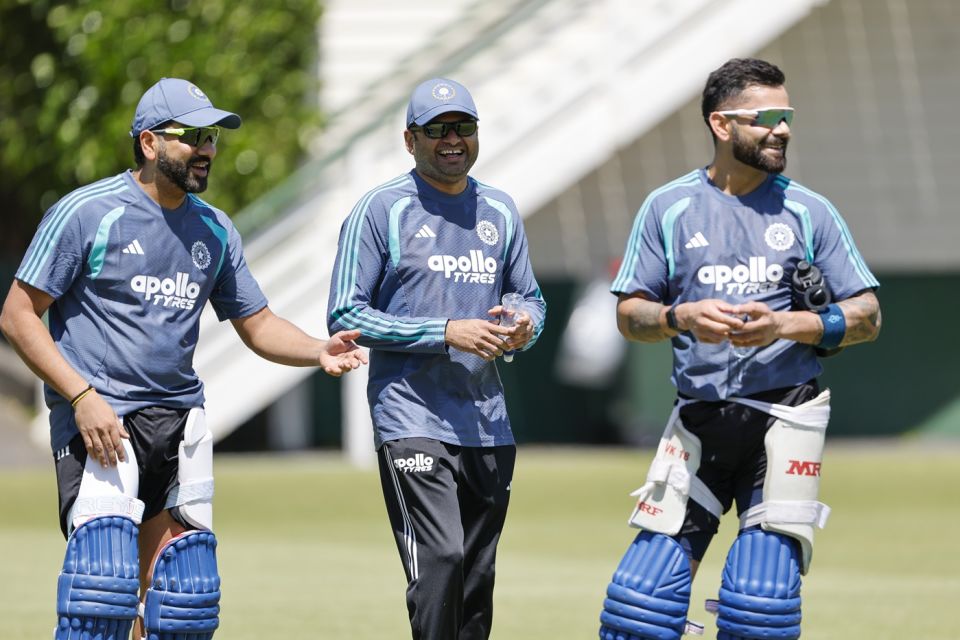
It was clear this was how it would be even three days before this game, when Kohli had a long open net at the middle of Eden Park's outer oval. He was facing a combination of three India fast bowlers - Gurnoor Brar, Anshul Kamboj and Auqib Nabi - and throwdowns, and apart from a small handful of occasions when the ball kicked at him from a length, he showed no respect to anyone. At times it looked like he was attempting to hit every ball - no matter what line or length - for six. There were a number of jaw-dropping shots, as you'd expect. There were also numerous miscues, because Kohli seemed to be testing the limits of what he could do.
On Wednesday, he batted in much the same way in a match, on one of the trickiest ODI surfaces India have batted on in recent times. No one who watched it will ever forget it.