


Cameron Bancroft's column on Sandpapergate is over 4000 words. For those who are unable to go through all of it, here's a TL;DR version of its main revelations and takeaways.
Ball-tampering in the 2017-18 Ashes
Usman Khawaja wrote in Sabr that there had been ball tampering in the 2017-18 Ashes. Bancroft backs up that claim, with more detail about how Australia ran ball maintenance.
That was Bancroft's debut series, where David Warner "carried significant responsibility for maintaining the condition of the ball." Bancroft said Warner "understood how to look after the ball and was highly regarded for his knowledge in that area.
Crucially, he remembers from his debut Test, "being instructed, along with other members of the team, to push the quarter seam of the ball together after the team took a wicket."
Recommended Read



No sandpaper in the Durban Test
There were a number of ways in which an older ball was maintained, not always involving foreign objects. Pat Cummins spoke about methods during his press conference last week, which Bancroft alludes to taking place in the first Test of the 2018 series against South Africa in Durban.
Bancroft writes sandpaper was not used, but more "traditional methods of maintaining the ball" were. He's not sure whether mints were used or whether the seam was picked because he was "not responsible for the ball in that Test."
Plenty of sandpaper in Port Elizabeth
Khawaja's book was the first time that claims of ball tampering in the Test before Cape Town - in Port Elizabeth (now Gqeberha) - were aired. Those claims have been backed up by Bancroft with considerable extra detail.
According to Bancroft's account, with South Africa in charge by tea on day two, coach Darren Lehmann and bowling coach David Saker and "other players moving in and out" were involved in discussions with him to make the ball reverse more. It was Warner who suggested sandpaper as a tool here. The captain Steve Smith "came into the conversation" but distanced himself from it.
As Australia took 4 for 28, Bancroft writes that he didn't just do it once. "This was an act I did nearly every over the whole last session on that day to begin with and then for the remainder of that Test match, up until I was caught in Third Test in Cape Town."
Who knew what?
This has been the central tension of Sandpapergate. Khawaja wrote that everyone knew. David Warner, Chad Sayers and now Bancroft have backed him up. The bowling quartet of Cummins, Mitchell Starc, Josh Hazlewood and Nathan Lyon have repeatedly said they didn't know sandpaper had been used.
Bancroft's account suggests strongly, in several places, that the bowlers must have known. About that session in Port Elizabeth, he writes: "During that period, I regularly spoke to the bowlers about how the ball was behaving. I had to."
They gave him feedback on whether it was working. "The conversations about the effect the sandpaper was having on the ball were regular, very natural and organic on the field. It is as it is."
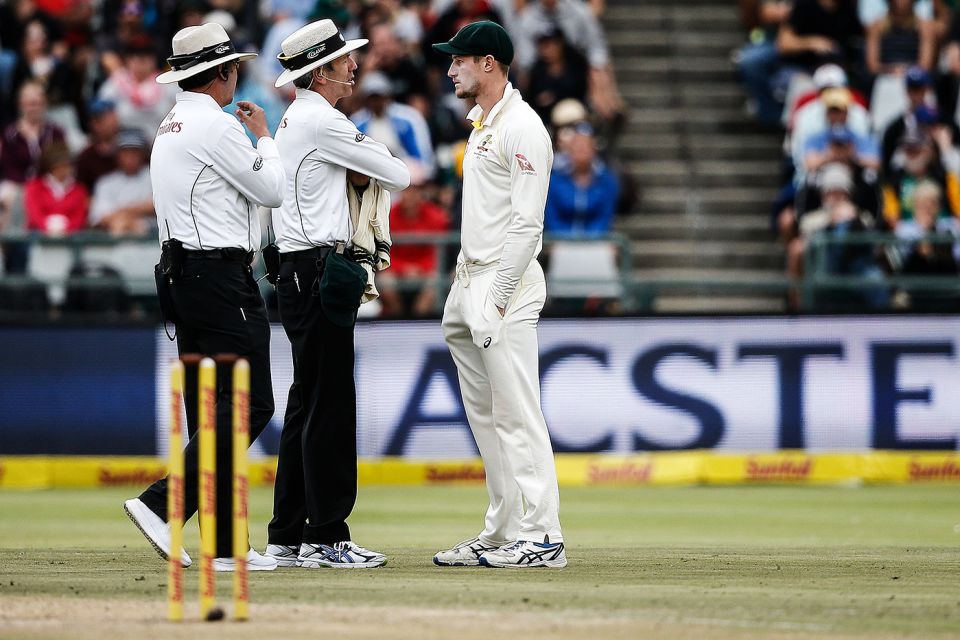
Before play on day three, Bancroft writes, "we gathered for our usual team chat before warm-up." They celebrated the successes of the day gone. "I remember my ball tampering with the sandpaper the evening before being discussed and my role being acknowledged in front of the group.
"Much like the celebrations when we took 28 for 4 the evening before, I received wraps and encouragement from members of the playing and coaching staff, especially David Saker."
In Cape Town, Bancroft says that Saker told him "I needed to do more with the sandpaper on the ball" to make it swing. "Once again the same conversations we had on the field in Port Elizabeth continued. Me asking for feedback from Starcy, Pat, Josh and Mitch about working on the ball like the Test earlier. They all told me what I was doing wasn't enough."
Once the Cape Town Test was over and the team met to discuss its fallout, Bancroft says, "Nobody in that meeting stood up and said they had been completely unaware of my use of sandpaper. Not one person."
Is this wiggle room?
Bancroft writes extensively about the 2021 statement issued by the bowling quartet (which excludes Mitchell Marsh) denying knowledge of sandpaper having been used. He says it was "deeply painful" and that he struggled to "reconcile those denials with my memories" of on-field conversations and "shared celebrations" in Port Elizabeth and Cape Town.
He then writes that he recognises "there is a distinction between knowing a ball is reversing, suspecting it has been altered and knowing specifically that sandpaper has been used." Does this leave a tiny bit of wiggle room to those specific denials, that the bowlers may not have known sandpaper had been used to tamper the ball?
An objector
After the day three meeting before play in Port Elizabeth, when Bancroft was lauded for his ball maintenance, only one person objected to what was happening: the team's media manager Kate Hutchison.
"I recall her making it clear that she believed it was wrong, that she wanted nothing to do with it, and walking away from the discussion.
"Somebody had demonstrated that being part of the team did not mean having to accept everything the team was doing. And I ignored it."
Her reaction, Bancroft writes, "is important because it completely challenges the idea that nobody had an opportunity to question what was happening."
Steve Smith, then captain, was not quite an objector. In those tea-time conversations in Port Elizabeth, Bancroft says Smith "came into the conversation and, as I remember it, made it clear that he wanted no part in it before distancing himself."
Bancroft's Australia career
Bancroft played two more Tests after Cape Town, the last in the 2019 Ashes at Lord's. And though he acknowledges that selection can be complicated, he did also begin to wonder whether the "unresolved tension" from that series played a role in curtailing his Australia career.
"Because in spite of having scored the most hundreds of any player in the [Shield] in the last six years, including featuring in the top-three run scorers for over half that period I have never had a look in.
"After my 'self-explanatory' public statement in 2021, I felt increasingly uncomfortable around some of the people involved. I wondered whether my presence in an Australian dressing room might bring back questions that others wanted to leave behind. I wondered whether the easiest option was simply not to select me which I believe to be quite unfair in my opinion."