
Test match (1): Australia 1, World XI 0
One-day internationals (3): Australia 3, World XI 0
The idea of pitting the leading team in the world against the best of the rest
sounded wonderful in theory but, in practice, "Super Series" proved a highly
inappropriate description of four one-sided games. Within an hour of the
World XI losing the Test match by 210 runs more than two days ahead of
schedule, the ICC's chief executive Malcolm Speed told a press conference
that there were no plans to repeat the exercise in this form, even though the
governing body's own website proclaimed that it was "expected to become a
regular feature... played every fourth year". Flaws in the concept soon became
evident, and the ICC, having cynically bestowed full Test and one-day
international status on the matches, seemed keener than anybody to move on.
To think of the games as exhibition matches is an injustice to Australia,
who were keenly competitive and desperate to remove any doubt about their
lofty status after conceding the Ashes. There was actually something quite
uplifting about the way that pride in a country proved greater motivation
than the prize fund of $US1,322,000, which was all the World XI had to
play for. Steve Harmison put it rather well when he described standing at
the end of his mark and looking down at his shirt, but finding no England
badge staring back to inspire him. And, as for the notion of the World XI
as cricket's Harlem Globetrotters, that was well wide of the mark: at least
the Globetrotters perform a few tricks.
The Ashes result a month earlier undermined Australia's claim to be the
best in the world, despite their official No. 1 ranking in both Tests and oneday
games. But only two England players made the World XI Test squad,
which was chosen by Sunil Gavaskar, Michael Atherton, Aravinda de Silva,
Richard Hadlee, Clive Lloyd and Jonty Rhodes. They overlooked Michael
Vaughan as captain in favour of South Africa's Graeme Smith, a decision
that might have been reversed had it been made a month or so later. Deadlines
were imposed, in part for practical reasons, but the ICC also milked all the
publicity it could as the Test squad was reduced from 30 (named on May
9) to 20 (on July 2) before the final parties were announced on August 23,
six weeks ahead of the first one-day match. Despite all this, at no point did
they look or feel like a proper team.
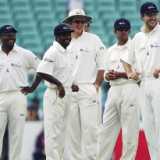
An initial plan to hold the event in South Africa was rejected. It seemed
only fair that Australia, the champions, should enjoy home advantage.
Knowledge of conditions certainly counted for something in the Test at
Sydney, when Shane Warne and Stuart MacGill created havoc with their
wrist-spin. But the fact that they were all match-fit after the Ashes was a
bigger asset. Some of the World XI, most conspicuously Brian Lara and
Jacques Kallis, appeared in desperate need of a hit. Shaun Pollock, an odd
choice to captain the one-day side when he was no longer in charge of his
own national team, suggested that a better time would be immediately after
a World Cup, when everybody would be in the swing of things and the
selectors could pick on form as well as reputation.
More pertinent was to question whether the concept was worth pursuing
at all. The ICC claimed that it had been cricket rather than marketing-led,
but Speed also described the "twin objectives" as "meeting event-revenue
targets and achieving maximum global audience". So where, critics inevitably
asked, did producing decent cricket rank among the priorities? This might
have been a little unfair. Speed sometimes appears to be scowling even when
he is happy, and as the days wore on his anger at the performances of the
World XI became increasingly clear. In a rare reversal, the players let down
the administrators for a change. But the fact is that it would not have gone
ahead without support from television.
Whatever the games looked like on the screen, they received a tepid
greeting from the Australian public. With the MCG undergoing redevelopment
before the 2006 Commonwealth Games, the Telstra Dome in
Melbourne's docklands was a cold, soulless substitute, never more than 60%
full during the three one-day games. At least the closed roof guaranteed play
on some rainy evenings. But nothing - not even the prospect of seeing the
Ashes hero Flintoff - shook or stirred to create a rush for tickets. Apart
from the visit of Zimbabwe in 2003-04, the crowd for the first three days
of the Test was the lowest aggregate at the SCG since 1996-97.
Statisticians continued to bemoan the granting of Test status. The ICC's
own board initially rejected a recommendation from its Chief Executives'
Committee to give the official stamp. They were asked to reconsider, having
approved a one-day game for tsunami relief, and did as they were told second
time around. There appeared to be no plausible reason why these games
should be sanctioned but not those between England and the Rest of the
World in 1970 and possibly the 1971-72 matches between Australia and a
World XI. The ICC's own regulations defined a Test as "Any cricket match
of not more than five days' scheduled duration played between teams selected
by Full Members as representatives of their Member Countries": despite this
they gave Test status to a six-day game (which was over in less than four)
between Australia and a composite XI. All in all, this was a fortnight where
credulity was best left suspended.