
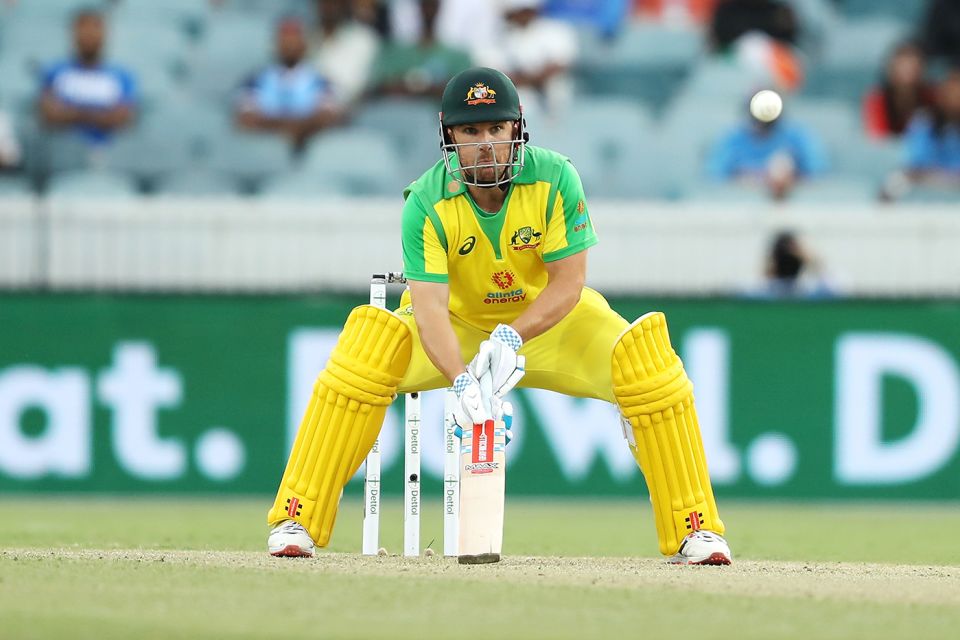


Aaron Finch was a titan of T20 cricket. He played nearly 400 professional matches in the format for 17 different teams, more than 100 of those for Australia, whom he captained to victory in the 2021 T20 World Cup. He spent eight consecutive years in the ICC's top ten batters' list in T20Is, and still holds the record for the highest individual score in a T20I innings (172).
Finch had a front-row seat as the format went from its early frivolous phase to becoming the serious business that brings in billions of dollars to the game as a whole. He made his T20 debut for Victoria in the Big Bash, played in the Champions League, and represented a record nine IPL franchises. In this interview, Finch talked about what he enjoyed about captaincy, the T20 World Cup win, why he was shunted around in the IPL, and whether the calendar is too overloaded today.
You made your T20 debut back in 2009. Was it a format that always suited you?
T20 was still very, very new at that stage. When I was starting out my professional career, I started with T20 as well, which gave me a little bit of help compared to some of the guys that had been playing first-class cricket for such a long period of time and then had to make a big transition. I caught that wave at the right time and it was always a game I loved: it's such a great format. To see the changes in the last 18 years of T20 cricket is extraordinary.
T20 was still very, very new at that stage. When I was starting out my professional career, I started with T20 as well, which gave me a little bit of help compared to some of the guys that had been playing first-class cricket for such a long period of time and then had to make a big transition. I caught that wave at the right time and it was always a game I loved: it's such a great format. To see the changes in the last 18 years of T20 cricket is extraordinary.
Did it feel like you were coming into T20 when it was starting to boom? The IPL had just started, and there were a lot of Australians going over to India to earn big money.
I was really lucky that when I debuted for Victoria, we were in the middle of a really strong period. We won four out of six Big Bash titles before it went to the current franchise-type set-up. I was really lucky to play with some players who had a lot of experience around the world, particularly in county cricket, [like] Dave Hussey, Cameron White and Brad Hodge. They were almost revolutionary in the way that they went about it, so it was a good time to come into T20 cricket.
I was really lucky that when I debuted for Victoria, we were in the middle of a really strong period. We won four out of six Big Bash titles before it went to the current franchise-type set-up. I was really lucky to play with some players who had a lot of experience around the world, particularly in county cricket, [like] Dave Hussey, Cameron White and Brad Hodge. They were almost revolutionary in the way that they went about it, so it was a good time to come into T20 cricket.
Aaron Finch on winning the 2021 T20 World Cup: 'Nobody gave us a chance and that was ammo for us'
Aaron Finch looks back at Australia's World Cup win while dealing with Covid-induced bubbles
How different was the cricket itself back then?
Very different. It was almost a bit of a hit-and-giggle still. Until the IPL came in, it probably wasn't taken as seriously as what everyone thought it should be. I mean, there were celebrities playing in domestic Big Bash games, and the philosophies on the game were very different.
Very different. It was almost a bit of a hit-and-giggle still. Until the IPL came in, it probably wasn't taken as seriously as what everyone thought it should be. I mean, there were celebrities playing in domestic Big Bash games, and the philosophies on the game were very different.
We had a coach who had a lot of success as a T20 coach - Greg Shipperd - with Victoria, and his philosophy was: if you can get 40 off the first six, none down, you've done your job. It would go to 45, and as the game started to evolve, it was like: if we can get to 60… but don't take any risk. Be none or one down, no more than that at the end of the powerplay.
It's just fascinating to see where the game's gone [since]. But it was just the reality of the times. People were still working out how to go about playing T20 cricket at the start.
You grew up playing all formats, and played nearly 100 first-class games across your career. Did you feel that those all-format fundamentals helped you, especially as an opening batter, with the challenges of the moving ball?
You still have to have a fundamental technique to fall back on. You see guys in T20 now who get really hot for a period and then really cold for a long period. It's just the fact that they don't have a fundamental technique to fall back on, and generally they're younger guys who are still trying to work out their game. Being a little older when I was exposed to international cricket and IPL, you've played more longer-form cricket in that period of time. There's been times during this IPL [2025] where everyone's been critical about teams not having a different gear to go to, so having that base is definitely beneficial. It certainly was for me. It just gives you another avenue to be successful more often.
You still have to have a fundamental technique to fall back on. You see guys in T20 now who get really hot for a period and then really cold for a long period. It's just the fact that they don't have a fundamental technique to fall back on, and generally they're younger guys who are still trying to work out their game. Being a little older when I was exposed to international cricket and IPL, you've played more longer-form cricket in that period of time. There's been times during this IPL [2025] where everyone's been critical about teams not having a different gear to go to, so having that base is definitely beneficial. It certainly was for me. It just gives you another avenue to be successful more often.
Does that depend on the role someone's playing? I can see why that would be more important for, say, Jake Fraser-McGurk than someone like Tim David, who has a very specific role at the back end of a T20 innings.
It's generally guys at the top of the order, where the ball does move every now and then. It doesn't swing for long, but when it does, it can be extreme in the first one or two overs of a T20 innings, and that's when you're most vulnerable as a player. You still have to have a platform to be able to launch your innings from. And if you just don't get that balance quite right first up, it doesn't take too many games for you to start doubting yourself - and then, all of a sudden, it's a flow-on effect.
It's generally guys at the top of the order, where the ball does move every now and then. It doesn't swing for long, but when it does, it can be extreme in the first one or two overs of a T20 innings, and that's when you're most vulnerable as a player. You still have to have a platform to be able to launch your innings from. And if you just don't get that balance quite right first up, it doesn't take too many games for you to start doubting yourself - and then, all of a sudden, it's a flow-on effect.
I guess that's the case with guys who are playing so much T20 cricket now - not having the opportunity to go back and work on their game with zero pressure. It's always guys trying to tinker with their game between matches or tournaments, or series for their country, where you might get two weeks - and that's not a huge amount of time to be able to change something in your technique to make you better. It's finding that balance of how to manage your career in such a chaotic world with zero rest for players.
As well as your main role as a batter, were you always interested in the strategic side of the game?
Yeah. I always captained junior and representative sides coming through, and that was a big part of my development, being exposed to the tactical side of it - and not just on the field, but off-the-field management. When you come into a new set-up, being a youngster, no one's asking for your opinion, so you're just sitting back and watching everything unfold and forming your own ways to go about things when you do get an opportunity.
Yeah. I always captained junior and representative sides coming through, and that was a big part of my development, being exposed to the tactical side of it - and not just on the field, but off-the-field management. When you come into a new set-up, being a youngster, no one's asking for your opinion, so you're just sitting back and watching everything unfold and forming your own ways to go about things when you do get an opportunity.
I always loved the strategy side of it, and as I continued and ended up captaining Australia, I loved the preparation. When you're playing against the best in the world, 1% is sometimes all you can find, and that's so important. Spending time with the analyst and going through different scenarios of what might happen was something that fascinated me.
What are your memories of taking it on for the first time, and working out just how chaotic a T20 game can be to manage for a young captain?
It is chaotic. When you first come in, you want to stamp your captaincy style on the team. I was emotional - far too emotional - when I first started captaining the Melbourne Renegades and then Pune [Warriors]. You want everyone to be so good, and you expect a lot of other people and from yourself as well. I didn't get the balance right when I first started captaincy, and even towards the back end, there were still times when I was an emotional captain. I tried to control it as best I could, but it's just the reality of it when it's high stakes and high pressure.
It is chaotic. When you first come in, you want to stamp your captaincy style on the team. I was emotional - far too emotional - when I first started captaining the Melbourne Renegades and then Pune [Warriors]. You want everyone to be so good, and you expect a lot of other people and from yourself as well. I didn't get the balance right when I first started captaincy, and even towards the back end, there were still times when I was an emotional captain. I tried to control it as best I could, but it's just the reality of it when it's high stakes and high pressure.
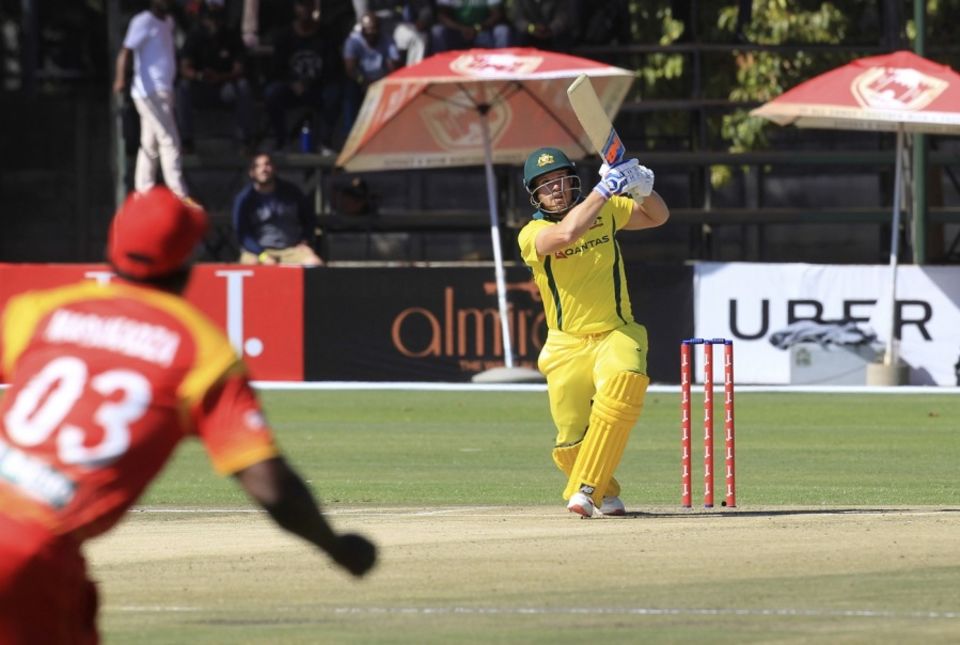
The tactical side of it always came pretty naturally. The ability to sit down and try to find 1% or 2% edges on an opposition is the part of it that I loved. I wish I enjoyed it more. I loved doing it - I loved every second of it - but I wish I appreciated how hard it is and embraced that, as opposed to searching for perfection all the time.
Were there times in your career where you were weighed down by that, and the role got on top of you?
I never really felt that side of it. I was always pretty good at separating the two, and understanding that my job as a batsman is to get runs at the top of the order. I was able to compartmentalise. That wasn't a part that I ever stressed about, or felt like it weighed me down. Maybe [it did] slightly towards the back end of my career, when I knew that I was coming to the end and I wasn't performing as well as I would have liked - and you had guys like Travis Head waiting in the wings, ready to go.
I never really felt that side of it. I was always pretty good at separating the two, and understanding that my job as a batsman is to get runs at the top of the order. I was able to compartmentalise. That wasn't a part that I ever stressed about, or felt like it weighed me down. Maybe [it did] slightly towards the back end of my career, when I knew that I was coming to the end and I wasn't performing as well as I would have liked - and you had guys like Travis Head waiting in the wings, ready to go.
How did you find captaining Australia vs captaining the Renegades vs captaining in the IPL? Which do you think was hardest, and which do you think suited you best?
IPL was probably the hardest, because you're coming together for a short period of time. At Pune Warriors [in 2013], I came in as a replacement player and then two or three games later, I was captain. I just didn't have the time to know everybody in the squad, which is really difficult. Captaining Australia, you've got some of the best players in the world all the time, so my job was pretty easy there. Everyone knows what they're trying to do.
IPL was probably the hardest, because you're coming together for a short period of time. At Pune Warriors [in 2013], I came in as a replacement player and then two or three games later, I was captain. I just didn't have the time to know everybody in the squad, which is really difficult. Captaining Australia, you've got some of the best players in the world all the time, so my job was pretty easy there. Everyone knows what they're trying to do.
The Melbourne Renegades was a squad I'd helped build from year one right until last year. There was a lot of pride in that. You're trying to build something great. The performances weren't always there, but it was just different. You're so invested in something you've been a part of. You think of someone like Virat [Kohli], who's been at RCB from the very start, or [MS] Dhoni [with Chennai Super Kings]. You're just so invested in everything that happens there that you want desperately to do well, and sometimes you want it too much. It's just totally different wherever you go.
Aaron Finch on coach Andrew McDonald: 'Times we'd be kicking and screaming at each other, but it was all fun'
Aaron Finch talks about the influence Andrew McDonald has had on his career, and how they led Melbourne Renegades to the Big Bash title together
You played for one BBL team, one national team, but nine franchises in the IPL. Why didn't you find the stability in India that you managed to find back home?
I wasn't as good in the IPL as I was playing for the Renegades or for Australia. At times, the pressure of trying too much and trying to force it a little bit much was there.
I wasn't as good in the IPL as I was playing for the Renegades or for Australia. At times, the pressure of trying too much and trying to force it a little bit much was there.
I made my debut with Rajasthan Royals. I played one match under Warnie [Shane Warne] as a replacement player, the last game of the year. It's funny how your career can take different turns. At the end of that year, I'd signed a three-year deal with Rajasthan. I was an uncapped player, and that was all above board at the time. We went to the Champions League, and I had already got my three-year deal with Rajasthan locked away. Everyone else was playing for an IPL deal, really, but it didn't bother me how I went, and I performed well. And then, just before the auction, they decided that everybody was in the auction. Now teams couldn't sign uncapped players [on longer contracts].
So then I ended up at Delhi [Daredevils] for a couple of years and didn't play a huge amount. There were guys like David Warner, KP [Kevin Pietersen], Ross Taylor, Mahela Jayawardene in front of me. After two years, when the team hasn't had success, you're the first one to go, because those [other] guys are superstars and legends. A few things like that just happened along the way. I played a year at Sunrisers [Hyderabad], where myself, Warner and Shikhar Dhawan were all in the same side. Three openers, mixing and matching between opening and batting three. It gets to the end of the year and they said, "Well, someone's got to make way." And it happened to be me.
That's the pressure of playing for one of four overseas spots, isn't it?
Yeah it is, but also how you are picked up at the time. If I use Hyderabad as an example, I was in great form internationally but didn't get the best out of [myself] that season. When you get to the end of it, Shikhar was an absolute gun at the time, and so was David Warner, so it's an easy decision for the franchise, and then you end up back in the auction. That can be a bit of a flow-on effect at times, not getting a really good run. But at the same time, if you get a lot of runs, you'll generally stay there.
Yeah it is, but also how you are picked up at the time. If I use Hyderabad as an example, I was in great form internationally but didn't get the best out of [myself] that season. When you get to the end of it, Shikhar was an absolute gun at the time, and so was David Warner, so it's an easy decision for the franchise, and then you end up back in the auction. That can be a bit of a flow-on effect at times, not getting a really good run. But at the same time, if you get a lot of runs, you'll generally stay there.
Do you look back and think, "I wish I could have played for one franchise?" Or do you think, "I must have done something right, because nine different teams wanted me?"
That's a good way to look at it. Either I was a good enough player to keep getting picked, or I just wasn't quite good enough to be that one- or two-franchise type player. Of course, I'd have loved to stay at one franchise the whole time. But that's one part of having a mega-auction every three years. Players probably missed that opportunity to really build a legacy at a club. There's not a huge amount of players that have done it right throughout. Even Rohit [Sharma] started at Deccan [Chargers, before moving to Mumbai Indians].
That's a good way to look at it. Either I was a good enough player to keep getting picked, or I just wasn't quite good enough to be that one- or two-franchise type player. Of course, I'd have loved to stay at one franchise the whole time. But that's one part of having a mega-auction every three years. Players probably missed that opportunity to really build a legacy at a club. There's not a huge amount of players that have done it right throughout. Even Rohit [Sharma] started at Deccan [Chargers, before moving to Mumbai Indians].
And particularly among overseas players…
Yeah, Shane Watson was a legend for Rajasthan [Royals] and then he goes and wins the title with Chennai [Super Kings]. It's just strange how it all works. When you turn up to a new franchise, it's all about meeting everybody and getting along with them, building new relationships there. Then before you know it, you're six games in and if you haven't performed well, you might be on the chopping block again. Whereas, in a perfect world, I would love the consistency of turning up and knowing what you're going to get, day in, day out. But it's just the reality of T20 cricket.
Yeah, Shane Watson was a legend for Rajasthan [Royals] and then he goes and wins the title with Chennai [Super Kings]. It's just strange how it all works. When you turn up to a new franchise, it's all about meeting everybody and getting along with them, building new relationships there. Then before you know it, you're six games in and if you haven't performed well, you might be on the chopping block again. Whereas, in a perfect world, I would love the consistency of turning up and knowing what you're going to get, day in, day out. But it's just the reality of T20 cricket.
Recommended Read

'T20 drains you mentally because every ball is an event'
News• Read More

Nicholas Pooran: 'The complete T20 batsman can bat at 135, 140 strike rate and then accelerate to 200'
News• Read More

Ricky Ponting: 'The default setting now for batting is T20 and everything else works around that'
News• Read More
You mentioned the Champions League earlier. What was that experience like, and is that a competition you'd like to see come back?
Absolutely, I'd love to see it back. That gave a lot of people a start in international cricket and the franchise circuit. Maybe the schedule these days is too packed for it to come back. To try and find a window to play a global tournament like that is maybe unrealistic, but I loved it. We played one in South Africa, one in India, and it was unbelievable. You're playing against the best players, and teams were stacked right throughout. It was high-quality competition and a lot of fun along the way.
Absolutely, I'd love to see it back. That gave a lot of people a start in international cricket and the franchise circuit. Maybe the schedule these days is too packed for it to come back. To try and find a window to play a global tournament like that is maybe unrealistic, but I loved it. We played one in South Africa, one in India, and it was unbelievable. You're playing against the best players, and teams were stacked right throughout. It was high-quality competition and a lot of fun along the way.
You've been a huge part of the Renegades in the Big Bash, so that title win - in 2018-19 - must have been something you cherished. You were working with Andrew McDonald, who you obviously know well. What were the key ingredients in that success?
Andrew's a brilliant coach. I've known him since I was 16, and we played a lot for Victoria together. He mentored me all the way through, and then for him to become the coach of the Renegades was really cool. The culture in the group was unbelievable. We had a lot of experience. The one thing that set us apart that season is that people were in form. Our death bowling was Kane Richardson and Harry Gurney, who were as good as anyone going at the time. They just shut down games every single time. There were never times when teams got away from you. The management was outstanding to get that balance of youth and experience. That foresight from Andrew, and his ability to see the long game, is crucial. He's done it with Australia for quite a while now and had a lot of success.
Andrew's a brilliant coach. I've known him since I was 16, and we played a lot for Victoria together. He mentored me all the way through, and then for him to become the coach of the Renegades was really cool. The culture in the group was unbelievable. We had a lot of experience. The one thing that set us apart that season is that people were in form. Our death bowling was Kane Richardson and Harry Gurney, who were as good as anyone going at the time. They just shut down games every single time. There were never times when teams got away from you. The management was outstanding to get that balance of youth and experience. That foresight from Andrew, and his ability to see the long game, is crucial. He's done it with Australia for quite a while now and had a lot of success.
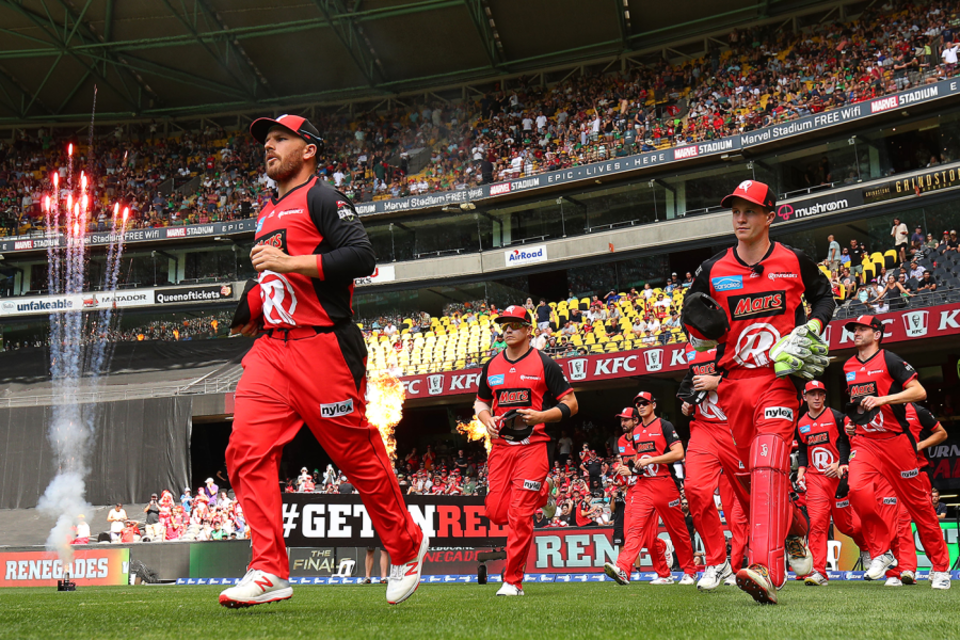
What worked for you and him as a coach-captain combination? Was the personal relationship a big part of it, or was it that strategically you were on the same page about what you wanted?
I was not always on the same page as the coach when it comes to strategy. Being so close from when I was 16 - he was maybe 20 or 21 - builds great trust, and as a player, if I was ever doubting something, I'd always go to him.
I was not always on the same page as the coach when it comes to strategy. Being so close from when I was 16 - he was maybe 20 or 21 - builds great trust, and as a player, if I was ever doubting something, I'd always go to him.
We disagreed on certain things quite a lot - especially selection. He always had the philosophy that if there was a batting decision to be made, he would get that call. As a player, you tend to not look outside of what you need right then and there, whereas as a coach, you can see a little bit more independently. If it was a bowling spot that we were tossing up, I would always get my way, because as captain I have to use them out on the field. If I don't trust who's being picked, I can't use the other four or five bowlers how I would like to either. There'd be times when we'd walk out of a meeting kicking and screaming at each other about things, but it was all great fun.
Let's talk about the planning side of it. You've said that analysts can take the creativity out of captaincy, but it seems like you did use them quite a lot during your captaincy career too.
I did, but in the lead-up to a game more so than in-game. That's still one part of it that I wouldn't personally as a captain, just because there are times when you need your gut feel. If you've got somebody throwing numbers out at you the whole time - "This person has to bowl this over for this reason" - that's when your creative flair as a captain can be really diminished. There's times when it goes pear-shaped as well, and you wear that decision as a captain; that's what you're there for. You generally wear it the hardest when you lose and cop the least praise when you win. That's reality, and that's fine. You don't do it to get pats on the back. What you do it for is to win games and to get the best out of people.
I did, but in the lead-up to a game more so than in-game. That's still one part of it that I wouldn't personally as a captain, just because there are times when you need your gut feel. If you've got somebody throwing numbers out at you the whole time - "This person has to bowl this over for this reason" - that's when your creative flair as a captain can be really diminished. There's times when it goes pear-shaped as well, and you wear that decision as a captain; that's what you're there for. You generally wear it the hardest when you lose and cop the least praise when you win. That's reality, and that's fine. You don't do it to get pats on the back. What you do it for is to win games and to get the best out of people.
Overall, you do all the planning and preparation to give yourself as much information as you can possibly need. I talked about the 1% or 2% that you're looking for in match-ups, but at the end of the day, you need your eyes to do the majority of the work for you. You see the game in front of you, you sum it up, and you try your best to make the best decision for that exact time. When you're playing against the best in the world consistently, they're allowed to be better than you as well on the day. It's understanding that it's not all about winning and losing. Fans don't want to hear that, but the process that you go with, you might've got it right 100% of the time in that game and that still doesn't guarantee you success. In Test cricket, you've got five days to grind out a result. ODIs, you've got 50 overs. In T20, it can be one ball that can change the momentum of the game so dramatically. It's about understanding that and taking that emotion out of it.
Aaron Finch on the explosion of T20 leagues: 'I worry about the treadmill the players are getting on to'
Aaron Finch on the concerns he has for players struggling to adjust mentally, physically and tactically to the overloaded cricket calendar
By the end of your career as a captain, when you'd have had a pretty good idea about most of the players in the opposition, what would you actually be asking an analyst - or a coach - for? Would you be looking for anything that a player has changed in the last couple of years? Has he added anything to his game?
You're trying to pick holes in players' swings, particularly the power-hitters. That's where the game has slightly changed. If you go back five years, the power-hitters were the flavour of T20 cricket and they were so important. Teams wanted that acceleration towards the back end, [so you are] trying to pick holes in guys' swings, their arcs, and what they want. Seeing footage, seeing data to back up footage. Your mind tells you: this is what I see. Can I get any information to back that up from the analyst?
You're trying to pick holes in players' swings, particularly the power-hitters. That's where the game has slightly changed. If you go back five years, the power-hitters were the flavour of T20 cricket and they were so important. Teams wanted that acceleration towards the back end, [so you are] trying to pick holes in guys' swings, their arcs, and what they want. Seeing footage, seeing data to back up footage. Your mind tells you: this is what I see. Can I get any information to back that up from the analyst?
Sometimes, they are like, "No, that doesn't match up." But there's something there that I've seen that I have a hunch on, so you're trying to dig into what that might look like. If you think back to some of the brutal death hitters, Andre Russell throughout his career has been unbelievable. Trying to find a weakness in his game at a particular time when he is the best in the world is difficult to do, but there might be one thing that you can do and it might be one ball - the flow-on effect. The structure of that over then changes. I loved just trying to find small things like that.
Did you have that gambler's mentality as a captain…
Yes!
Yes!
…where you would think, so long as I'm happy to stick with this decision and I think there's enough to go on, I'm willing to live with it not working?
There's a time and a place for it, and that's where the gut feel comes in as well. There's time in the game where you understand the importance of that one over that we need a wicket, and that's where it comes back to the preparation and all the work that you've done in the lead-up. You're not making blind decisions. I'm not just making a decision based on no evidence. [As] the person sitting on the couch, you might go, "Wow, this is a huge risk." Of course, every over is a huge risk, but there's a reason why it's happened. It's not just "I'm going to bowl this person just because I thought of it right now." You've done all that planning and preparation in your head that you think, "What do I need right now? Who's the best to go to? I might need him down the track. Let's roll the dice a little bit." The night before, you're thinking, "If I have to roll the dice in this position, this is who I'm going to." It becomes a part of the game that you learn to live with, because it doesn't always work.
There's a time and a place for it, and that's where the gut feel comes in as well. There's time in the game where you understand the importance of that one over that we need a wicket, and that's where it comes back to the preparation and all the work that you've done in the lead-up. You're not making blind decisions. I'm not just making a decision based on no evidence. [As] the person sitting on the couch, you might go, "Wow, this is a huge risk." Of course, every over is a huge risk, but there's a reason why it's happened. It's not just "I'm going to bowl this person just because I thought of it right now." You've done all that planning and preparation in your head that you think, "What do I need right now? Who's the best to go to? I might need him down the track. Let's roll the dice a little bit." The night before, you're thinking, "If I have to roll the dice in this position, this is who I'm going to." It becomes a part of the game that you learn to live with, because it doesn't always work.
Let's talk about the T20 World Cup in 2021. It had been five years since the last one in 2016, when you'd been captaining the side and in red-hot form in the lead-up but suddenly found yourself out of the team. Was that on your mind five years later?
No, not really. I think I'd got over it by then. It took a long time to get over it [though], no doubt. I was in great form at the time in 2016. I'm still unsure why I got left out for that first game against New Zealand, but that happens… Maybe I haven't let it go quite enough!
No, not really. I think I'd got over it by then. It took a long time to get over it [though], no doubt. I was in great form at the time in 2016. I'm still unsure why I got left out for that first game against New Zealand, but that happens… Maybe I haven't let it go quite enough!
But the 2021 World Cup was a really special one to win, because it was Covid times and we were locked down in [isolation] bubbles. The group was so tight: it was ridiculous how invested everyone was in that tournament. Nobody gave us a chance from the outside. You look at all the pundits who ranked the teams and no one gave us any opportunity, so that was a bit of ammo as well. We knew that we had a very, very good team and we made one tactical change right before the tournament. For the two years leading up to that World Cup, we thought that we'd go in with two spinners, [Ashton] Agar and [Adam] Zampa.
You're going back to the analytics in this regard. We thought that in the UAE, spin has to play a big part through the middle, but then the more you looked into the stats, the more the numbers suggested [that] if you don't get powerplay wickets, you don't win the game. It doesn't matter who your spinners are through the middle, if you don't get powerplay wickets, you're gone. That's where Josh Hazlewood would come back into it, and you go, "If I need wickets up front, am I going to go to Ashton Agar first up in the powerplay?" Which is a role that he hadn't really played. "Or am I going to Josh Hazlewood, who's got an unbelievable record?" That was the reason we made the change, understanding the importance of wickets early on.
You also ended up going with the extra batter, relying on four overs between Marcus Stoinis and Glenn Maxwell. That was arguably decisive: it meant you could go as hard as you wanted at the top, and felt like a big shift.
Justin Langer was always really strong on having the five best bowlers and not leaving it up to the allrounders, but it was just reality that you needed your seven genuine batters in that tournament. We felt Maxi and Marcus Stoinis could do that role of the fifth bowler right throughout. That was a big change. Agar was really stiff. He came in for the game against England, purely a match-up for Jos Buttler and Jason Roy up top, which didn't go to plan.
Justin Langer was always really strong on having the five best bowlers and not leaving it up to the allrounders, but it was just reality that you needed your seven genuine batters in that tournament. We felt Maxi and Marcus Stoinis could do that role of the fifth bowler right throughout. That was a big change. Agar was really stiff. He came in for the game against England, purely a match-up for Jos Buttler and Jason Roy up top, which didn't go to plan.
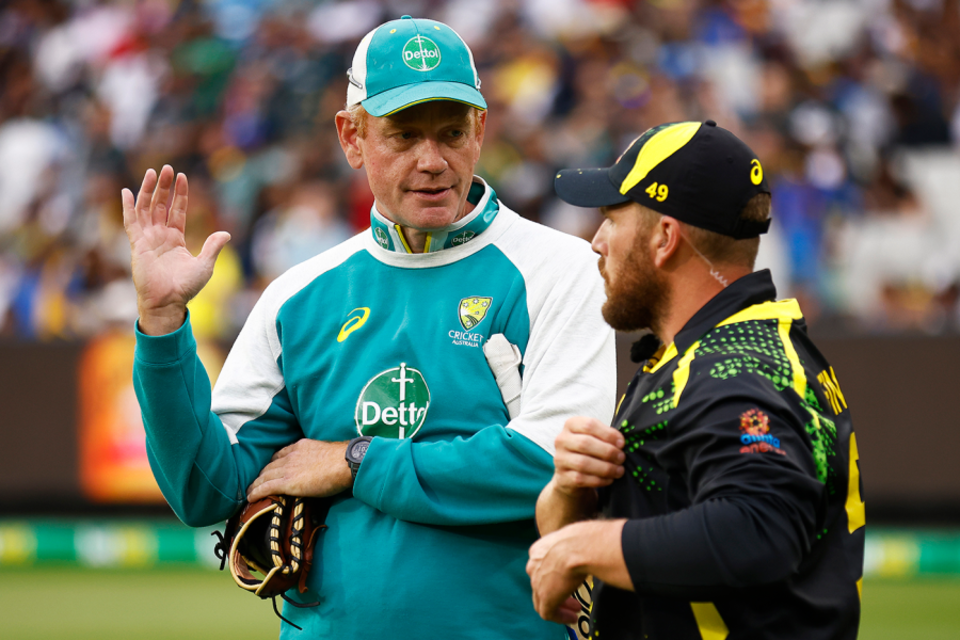
But the resilience of the group, the tightness, the genuine care for each other… that doesn't happen all the time. To have everybody excited for each other's success is probably as important as anything in a World Cup - 50-over or T20 - because it doesn't happen all the time. The squad mentality is so crucial. You have to enjoy other people doing well. Yes, of course, everyone wants to play, but it's just not possible. But we all get the benefit of it in the end. If it goes well, everyone gets a medal.
The build-up had been chaotic as well. You'd toured Bangladesh and the Caribbean, playing in empty grounds and on some pretty tough wickets. Did that help develop the culture that emerged in Dubai?
Yeah. I think that whole period of the Covid bubbles and the isolations - we were locked down in Australia quite a lot anyway - just brought everyone together. It made everybody appreciate the time you had with each other and whether it was sitting down after a win celebrating, or sitting down after training together, it was what it's about. You can go on some tours where, for example, if you go to the UK, you're in the middle of London, there might be two or three guys going off for dinner one way, two or three the other, and there's families everywhere and everyone wants to be a part of that. You're [only] coming together for cricket. Whereas when it was the Covid bubbles, we were together 24x7. It was not ideal overall, but it brought our group so tight together.
Yeah. I think that whole period of the Covid bubbles and the isolations - we were locked down in Australia quite a lot anyway - just brought everyone together. It made everybody appreciate the time you had with each other and whether it was sitting down after a win celebrating, or sitting down after training together, it was what it's about. You can go on some tours where, for example, if you go to the UK, you're in the middle of London, there might be two or three guys going off for dinner one way, two or three the other, and there's families everywhere and everyone wants to be a part of that. You're [only] coming together for cricket. Whereas when it was the Covid bubbles, we were together 24x7. It was not ideal overall, but it brought our group so tight together.
England thrashed you in the game you mentioned in Dubai. It was the sort of result that could have derailed you. Is that when team culture comes into it?
It was extraordinary. We had to flog Bangladesh in the next game, which saved our net run rate. We had to beat West Indies in the last game and hope South Africa didn't chase down their target [against England] too quick. A lot of things went right in the World Cup as well, so it felt like it was meant to be. There were six out of seven tosses that I won; the one that I lost was against England and we lost the game. A lot of things went our way, but we also played some very, very good cricket throughout.
It was extraordinary. We had to flog Bangladesh in the next game, which saved our net run rate. We had to beat West Indies in the last game and hope South Africa didn't chase down their target [against England] too quick. A lot of things went right in the World Cup as well, so it felt like it was meant to be. There were six out of seven tosses that I won; the one that I lost was against England and we lost the game. A lot of things went our way, but we also played some very, very good cricket throughout.
The T20 landscape has changed a lot since 2009, with IPL franchises owning teams around the world. There are clearly huge opportunities for players, but do you think the T20 landscape is in a healthy spot? Do you ever look and think, "There's a lot of games here where not enough people care about the result?"
It's a great question: is the T20 landscape becoming flooded? Potentially, slightly. To me, international cricket is still the number one. As a player, as a spectator, as a lover of cricket, no matter what format of the game, I love the international side of it, but I think it's just reality that it's going to keep getting forced into the franchise system, and then international cricket will start fitting around that.
It's a great question: is the T20 landscape becoming flooded? Potentially, slightly. To me, international cricket is still the number one. As a player, as a spectator, as a lover of cricket, no matter what format of the game, I love the international side of it, but I think it's just reality that it's going to keep getting forced into the franchise system, and then international cricket will start fitting around that.
I worry a little bit about players getting on such a treadmill of playing day after day that they're not going to have enough time to adjust mentally, physically, technically, tactically. There could be a case that you're not going to see the best of players for long enough. If you think back to AB de Villiers, the best T20 player I've ever seen, some of the stuff that he used to do is ridiculous. But he'd play for South Africa and RCB, generally, and not a huge amount in between. He'd only play the odd franchise [tournament] here and there, so he was always fresh, ready to go.
Now, someone's going to play in the IPL or PSL or in South Africa, Big Bash, the Hundred and then Bangladesh, New Zealand, the UAE. Players can literally be hopping around the world, month after month. The longevity of it for the players, I just worry about that slightly.
How have you enjoyed your transition into broadcasting?
It's a great challenge. I love watching cricket. If I wasn't broadcasting, I'd still be watching it. I hope that I can bring something to the coverage where you're able to try and explain not just what's happened, but explain why it's happened - what might have forced a player to make that mistake or execute that delivery. I love turning up to games to commentate. Even coming in here [to the ESPNcricinfo studio], talking about cricket in a way that I would do if I was sitting on the couch with mates, it's great fun. Hopefully, people enjoy it.
It's a great challenge. I love watching cricket. If I wasn't broadcasting, I'd still be watching it. I hope that I can bring something to the coverage where you're able to try and explain not just what's happened, but explain why it's happened - what might have forced a player to make that mistake or execute that delivery. I love turning up to games to commentate. Even coming in here [to the ESPNcricinfo studio], talking about cricket in a way that I would do if I was sitting on the couch with mates, it's great fun. Hopefully, people enjoy it.