
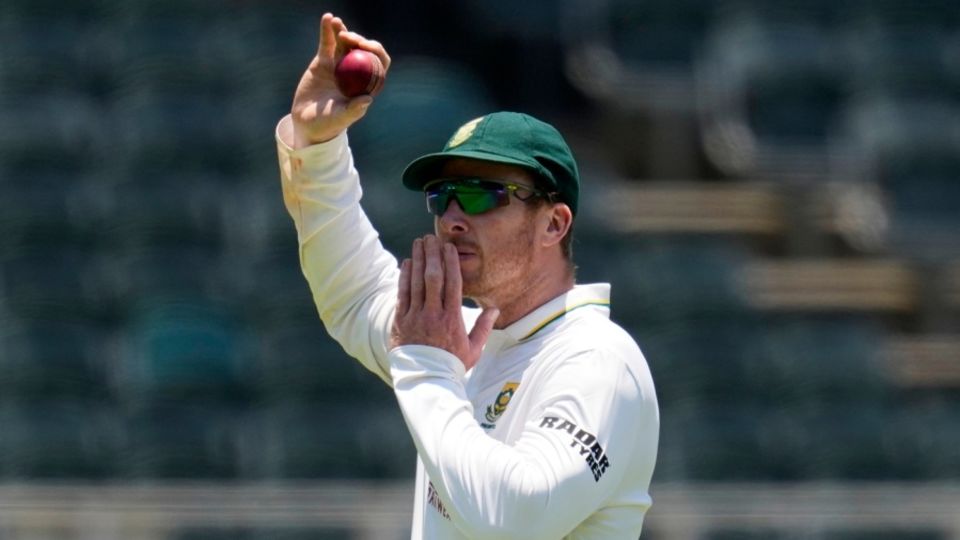


No-one in the history of Test cricket has been better than Simon Harmer in the second innings and the only person who come close is from 142 years ago.
England's Robert Peel averaged 14.25 in second innings, among bowlers who have taken at least 50 second-innings wickets, followed by John Briggs (16.83), Hugh Trumble (17.23), Jim Laker (18.58) and Noman Ali (18.74). Harmer? He averages 14.09. All six of those mentioned are spinners, which stands to reason, given that the second innings is the time when their efficacy is at its best. Next on the list is Kagiso Rabada, with a second-innings average of 19.16.
No wonder South Africa claim their attack is not just the best in the world but also the most varied. "From a bowling attack [point of view], we really have all our bases covered. With fast bowling, we've got guys like Pato (Dane Paterson) and (Wiaan Mulder) Wessie who will challenge technique, and then you've got the slower bowlers, at the moment being led by Simon. When the conditions are there, they're able to exploit it. It really makes us fierce from a bowling-attack point of view," Temba Bavuma said at the post-match press conference. "Bowling has always been a strength of ours. Now it's just been strengthened [further]."

The selection of Harmer after last year's World Test Championship (WTC) success has already been well documented as South Africa came away with three wins from four matches in the subcontinent last year. Harmer was seen as part of a horses-for-courses approach, someone who did the job asked of him abroad. It's come as something of a surprise that he replicated the same at home, to the point where he has been preferred over Keshav Maharaj, South Africa's first-choice for almost a decade, but perhaps it shouldn't have. Harmer has the second most number of first-class wickets in South Africa, 27 and years of upskilling, experience and match-winning performances on the country circuit.
Harmer's attributes are obvious to see but difficult to play against. He turns the ball substantially, is not scared to spin it from well outside off stump, and with his height, gets extra bounce. Bavuma was correct in saying that (other than Nathan Lyon), the "more classical offspin" is something "we haven't seen a lot of in world cricket, really." Left-arm spin a la Maharaj has been more of a recent threat but years of plugging away, winning matches for Essex - for whom he has 548 wickets - has given Harmer all the tools to perform at the highest level and he showed it again at the Wanderers against Bangladesh.
After going wicketless in a tough first innings, Harmer cleaned up on the final morning, having already had the opposition captain, Najmul Hossain Shanto, caught at slip and their debutant opener Mahfijul Islam, bowled off by a beauty that pitched on fifth stump and spun in. Today, he asked the batters to have a go and when they did, it cost them. Mushfiqur Rahim advanced down the track to try and take him on, and gloved him to short leg and Mehidy Hasan Miraz was stumped when he danced down the track and missed. Hasan Mahmud was foxed by turn and bounce and fended to short leg and Ebadot Hossain caught on the deep-midwicket boundary playing a get-me-outta-here shot. Those two wickets in two balls ended the innings, sealed a second successive six-for for Harmer, who continues to be hailed as a hero by his team-mates.
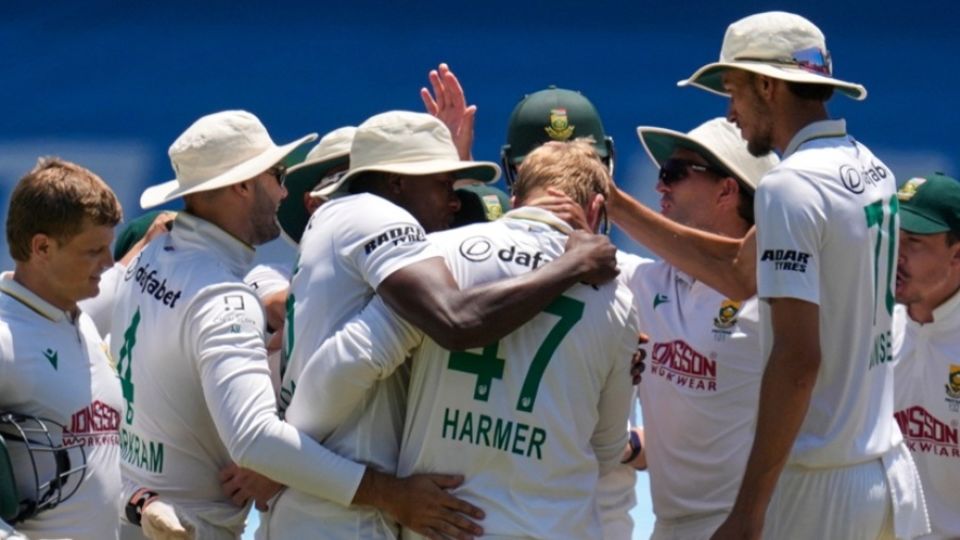
"Simon's a veteran. The ultimate warrior. When you can string a partnership together, [put] pressure coming from both ends, it makes it a lot easier and a wicket is inevitably about to come," Rabada said. "Simon, I'm lost for words. He's done it for his whole career, even in England. And he still wants to play for the badge. You can see the passion that he possesses. It's infectious."
For Rabada, whose pumped-up celebrations depicts a different kind of South African spirit, to be inspired by Harmer speaks more than anyone else speaks to the impact the offspinner is having. Perhaps the only question for him is: for how much longer? Harmer is 37 and has not hidden away from the fact that he is in the final years of his career and sees every match as an added bonus, a blessing, even. All he wants is to make the most of it for as long as he can. The next, and more awkward question is where does that leave Maharaj?
Maharaj has now missed three successive Tests and was released from the squad during the Wanderers Test for first-class duty. The match he is playing - for Dolphins against Western Province - is only scheduled to end on Sunday, so unless he is withdrawn from it early, it's highly unlikely he will play in the second Test against Bangladesh starting Monday. That would make it four consecutive Tests without him for South Africa. Their next series is against England, and the three Tests will be played at the Wanderers, SuperSport Park and Newlands. Harmer already has six-fors at two of those venues and it is as difficult to see how South Africa will leave him out as it is for them to try and accommodate two spinners.
Maharaj's next chance may only come in Sri Lanka, where South Africa play two Tests in March but no-one wants to say that just yet. Bavuma mentioned Maharaj unprompted when discussing his much-vaunted attack. "We've seen it right over the years with Keshav, who brings a different type of spin threat," Rabada said while adding Harmer's form and Maharaj's reputation "creates really good, healthy competition within the team."
"No one is really safe, really, if you look at it now."
Rabada himself is and had Bavuma not picked an injury, he would be too. The captain will be in the dressing room, reminding his team of the mantra they have adopted this summer which Harmer, and Rabada are living by. "I spoke about how we wanted to be a lot more ruthless. That looks different to everyone," Bavuma said. "we want to continue giving guys the freedom to play according to how they see it and be courageous as well, to deal with whatever consequences that come with it. Rather err on the positive side than the cautious side."
And so the South African juggernaut rolls on.