
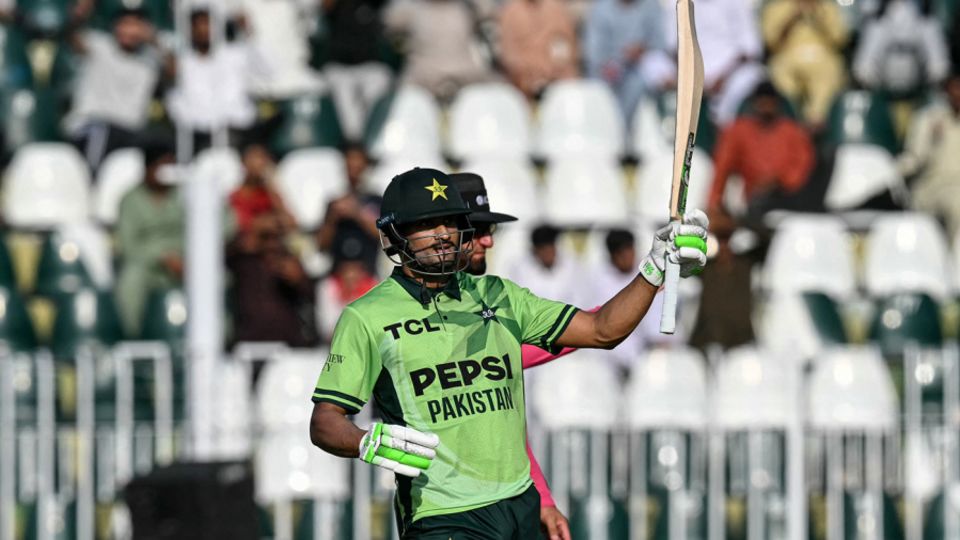


Hasan Nawaz sensed an opportunity when he walked to the crease with his team in freefall. Pakistan were at a precarious 81 for 4 inside 19 overs when he joined Saad Baig in the middle. Their most reliable batter in the last two years, Salman Agha, had just swept a full toss from Adil Rashid straight to Gus Atkinson at deep fine leg. This was when many would have ceased to entertain the thoughts of a total beyond 300. But Nawaz - playing his second ODI since his return to the side after almost a year - was not going to go without a fight.
Facing his first ball, he thumped one of the most-feared legspinners in the game down the ground for a gigantic six to announce his arrival. That shot, on the surface, only added six to the total. But it also - to a certain extent - helped redress the balance of the contest.
England captain Harry Brook had earlier bargained on the possibility of dew in the second innings when he inserted Pakistan at the toss. Rawalpindi is one of the most batting friendly white-ball venues in Pakistan with the true surface and smaller dimensions making run-scoring straightforward. The presence of dew under lights further tilts the balance in favour of batters, which makes a target of anything under 300 subpar.
Pakistan experienced that first-hand against Sri Lanka when a brilliant 119-run stand between Pavan Rathnayake and Janith Liyanage - either side of a collapse - threatened to overhaul Pakistan's 305 on Sunday. The foundations of that 305 had been built on a magnificent century from Agha. On Tuesday, Pakistan's largely inexperienced and young middle-order was put to test again after yet another poor showing by their experienced top order. With Agha no more in the middle to steer them out of the crisis, it brought Nawaz more into focus.
Recommended Read



It was not long ago that Nawaz was omitted from the white-ball squads for being reckless. He has been mature and composed since his return. He had not been afraid to buy time in the middle to settle in, which he did against Sri Lanka and again against England in his only second half-century in six ODIs.
That monstrous six against Rashid down the ground followed a period in which Nawaz milked the bowlers around for ones and twos, looking to take his innings deep. He worked the pace and spin all around the ground to run singles and seemed at ease when his punches and whips went to the fielders.
In between the periods of calm, he jumped out and moved around in the crease to access the gaps. One such moment almost cost him his wicket when he ramped a quick and flat offspin delivery from Will Jacks behind square where Atkinson shelled a chance. Nawaz was on 28 off 30 at that time. He became more measured in his shots after that and was happy to score only one of the five balls he faced from Rashid in the next over.
Nawaz looks more certain about his ability to pick up boundaries and Agha provided a peek into it after Pakistan's win over Sri Lanka as he noted that the conversation during his 97-run stand with Nawaz was based around how the two batters can afford to score slow early in the partnership, since they can cover up for it in the latter stages with their aggressive strokeplay.
Nawaz struck his second of the four sixes in his career-best innings of 79 off 74 on the 39th ball when he clobbered Atkinson over cow corner. He hammered Rashid down the ground two balls later and soon brought up his half-century with an elegant carve through backward point, riding the bounce of Jamie Overton's back-of-the-length delivery.
All these boundaries came inside eight balls before the second drinks of the innings. The first ball after drinks? He launched Rashid's legspin straight over his head for his fourth six of the innings.
As Pakistan's scoring rate swelled past five an over after this blazing passage of 11 balls, Nawaz switched back to lower gears to prolong his stay in the crease. After all, Pakistan had only one recognised batter in Faheem Ashraf left after being five down. Any blunder here could jeopardise all the hard work.
"The coach provides you a plan which was to build a partnership, but you, as a player, also make one when you walk in the middle," Nawaz said. "Mine was simple, to put 300 on board as I knew we needed to score that much to make a competition out of this game.
"I had said in the team meeting as well that we needed to score 320 in this match as 250-270 would not have been enough against this opposition. We knew this is a side which would either get out on 240 or chase a total inside 40 overs, considering how they bat."
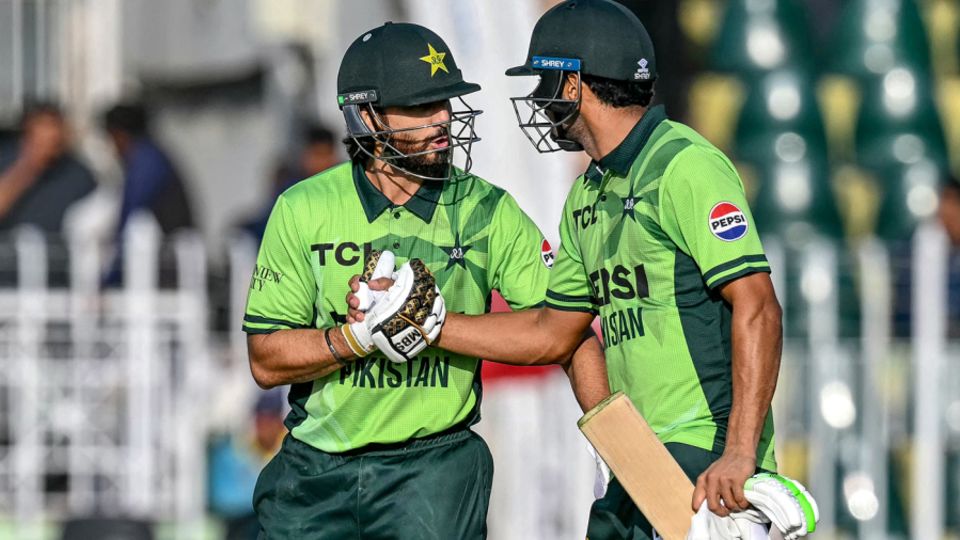
Nawaz ticked off both the plans as his innings not only propelled Pakistan beyond 300 but he spearheaded crucial partnerships with Baig (52 off 53) and Arafat Minhas (78 off 74) for the fifth and sixth wickets. With Minhas continuing to look more comfortable, Pakistan's hopes of posting a stiff target for England, somewhere in the range of 330-340, seemed more plausible. But, he was worked over by Overton who pushed him on the backfoot with six consecutive balls across two overs before serving one right in the base of his stumps.
Nawaz stomped back to the pavilion, furious at himself. His annoyance, however, was not limited to the mode of dismissal, but to him it underscored the long road he is yet to walk.
"It was a good ball but I feel I need to work more on my fitness as my reflexes had gotten slow by then. He had bowled similar deliveries to me prior in the innings which I was able to dig out."
Though he could not stretch his innings into the last 10 overs, which he said he would have liked, it set the stage for Minhas and Ashraf to plunder runs as their sparkling stand of 72 from 49 balls saw Pakistan add 91 runs in the death.
This tri-series serves as a crucial preparation for Pakistan with the next year's World Cup less than 12 months away. They have even moved away from the raging-turners in favour of true and hard surfaces which support a tinge of green for this series to replicate what they are expected to encounter in South Africa, where they play the majority of their matches.
But, in what is another sign of Nawaz attaining maturity as a player, he is not looking that far. Things, after all, have never been this uncertain in Pakistan in living memory.
"I am not thinking that far," he responded to the question on whether he was eyeing the World Cup. "One should not be thinking that far anyway in Pakistan. But one should look to improve their game constantly. I believe that one needs to perform against big teams to make their name in the game. I embrace tough challenges and try to give my all."
Pakistan would hope he continues to embrace every challenge in his way with open arms.