
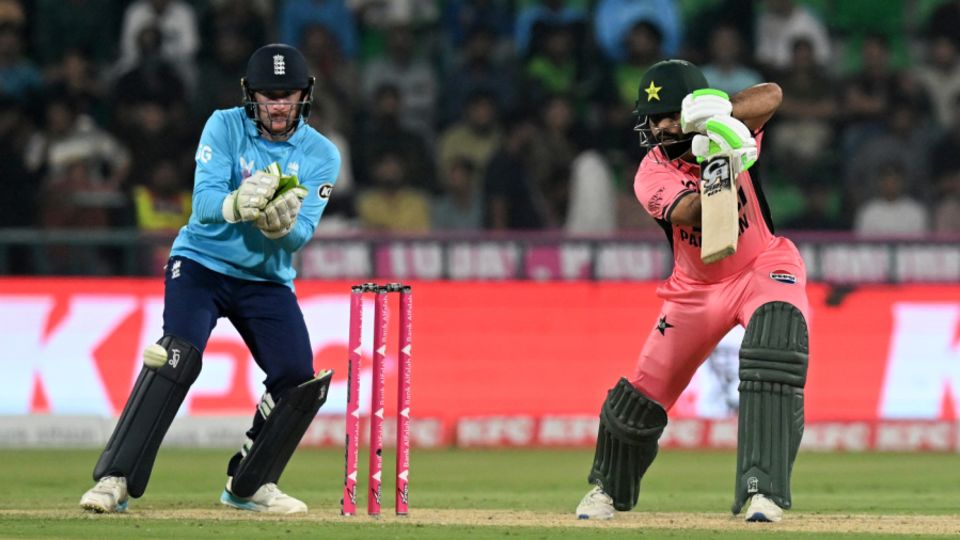




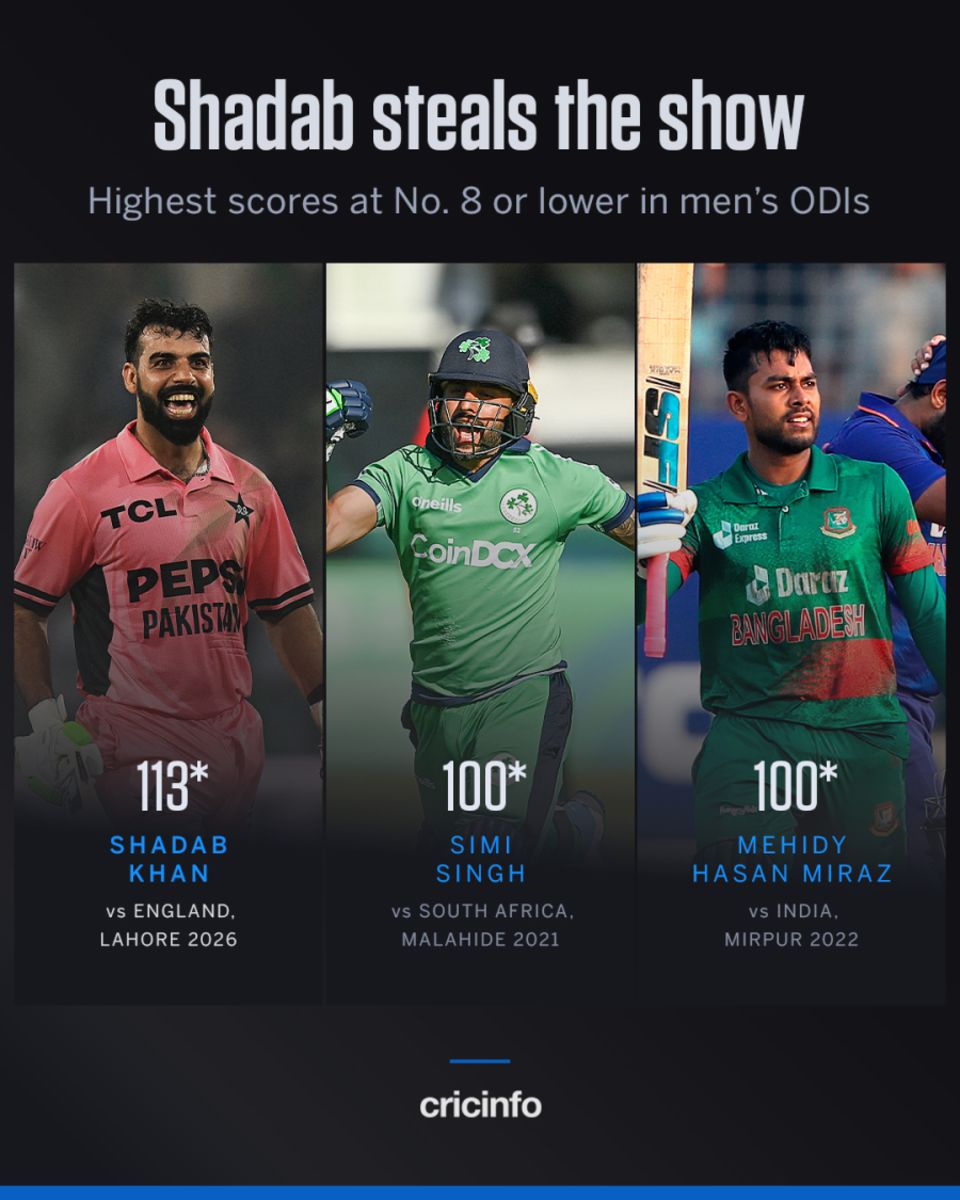
There have been more than 5000 ODIs, but never has someone scored as many as Shadab Khan did against England while batting at No. 8 or lower.
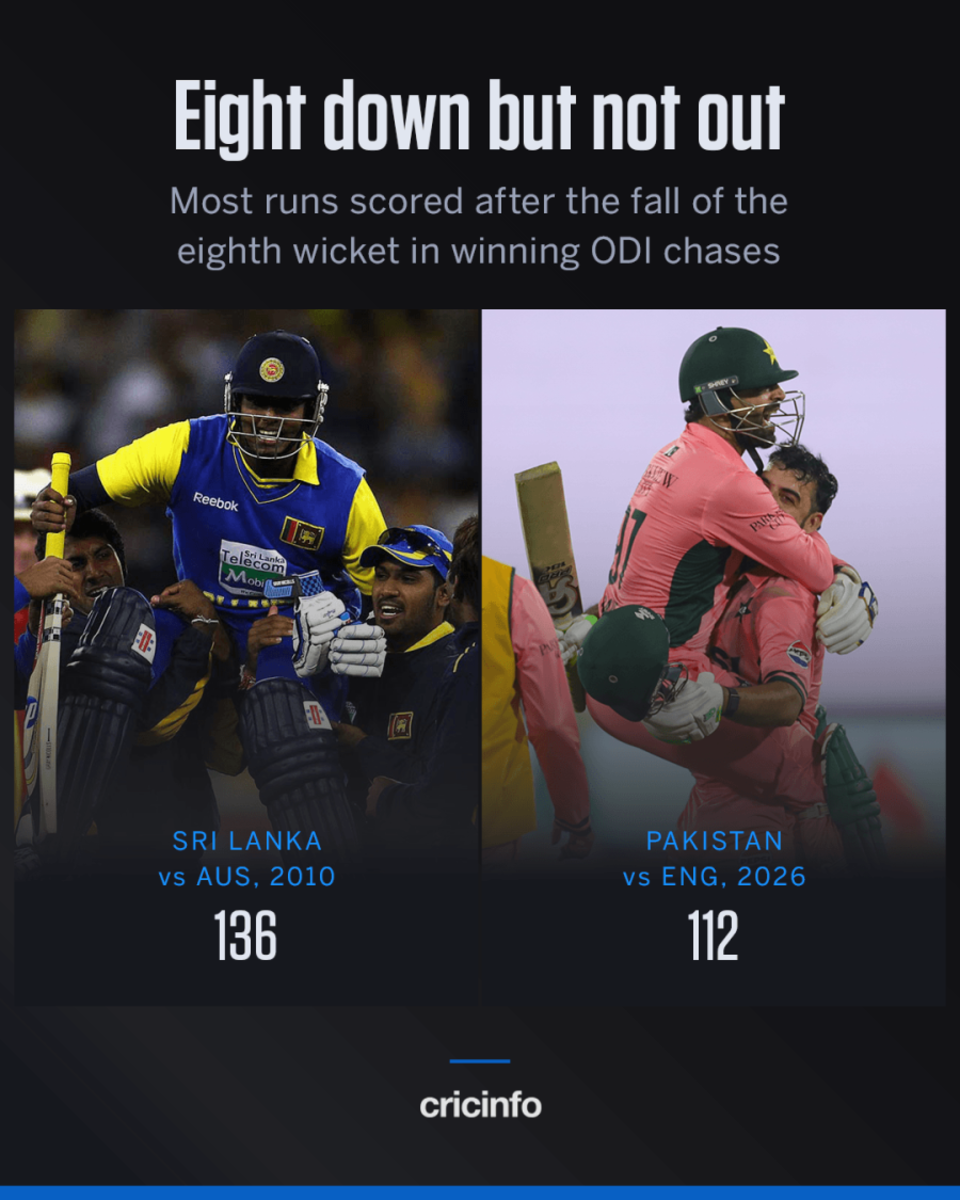
That underscores how significant his unbeaten 96-ball 113 was. That it spearheaded the biggest-ever stand for the last wicket in a successful ODI chase as Pakistan scripted a sensational one-wicket win further highlighted how remarkable his innings was.
Pakistan were staring at certain defeat just after the halfway stage of the chase of 242 in Lahore when Salman Agha holed out to long-off off Liam Dawson, leaving 120 runs left to be scored. Their captain Shaheen Shah Afridi, who can hit the ball long, followed him back in the next over, the 30th.
Recommended Read

Shadab, playing his first match of the tri-series after missing the first two because of a viral fever, watched the two dismissals from the other end as the crowd filtered out of the Gaddafi Stadium with each wicket rendering the home side's defeat a greater certainty.
He seemed unsure about how to go about his innings as he shuffled in and out of the crease and shimmied from side to side hoping to find gaps in the field. He scored only seven off his first 18 balls before striking his first boundary, swatting Jamie Overton over the top of his head by jumping out of the crease. That was before Agha and Afridi had fallen
What followed after initial hesitation was a knock for the ages, as he smashed 12 more fours and five sixes. Much of it was because of his ability to block out the external noise. "I block out the noise whenever I bat," he said after the match. "I was not sure what the crowd was chanting and I did not know what was happening around. I was in my zone."
****
There are few Pakistan players who needs to master that art more than Shadab.
His selection is questioned almost each time and he often gets called the coach's favourite. That he has struggled to deliver consistently has not helped his case. The rise of a young spin-bowling allrounder in Arafat Minhas - who has bagged Player-of-the-Match awards twice in six ODIs - has intensified the scrutiny.
What started as a promising career back in 2017 has wandered off the course as his effectiveness with the ball and his impact with the bat have dwindled with time.
He has played only four ODIs in the current World Cup cycle as Pakistan looked to move past him after the 2023 World Cup in which he averaged 118.50 with the ball as he took only two wickets across the 38 overs he bowled in five innings.
It was a continuation of his struggles in the format since the turn of the decade.
Since the start of 2020, the difference between his batting and bowling averages has bloated to -14.44, which is almost ten points worse than his overall numbers in the format. Pakistan even went into the Champions Trophy 2025 without him, but recalled him to the 50-over side earlier in the year when they hosted Australia in a three-match series.
"There have not been many performances from me in the recent past because of which I have received criticism and the management has faced criticism too," he said when asked how he had dealt with the last few years. "But a lot of credit goes to the management, who kept their faith in me. You try to improve as a professional. Unfortunately, things have not been clicking for me of late. But [as it seems] God was on my side today for which he set the stage for me."
****
The universe, indeed, seemed to be conspiring to make things comfortable for Shadab.
England, at one stage, were declared winners by 20 runs when a reverse-swinging yorker from Gus Atkinson landed on Shadab's boot right in front of stumps and the umpire's finger went up.
Atkinson had celebrappealed and Shadab had started to walk back. He smashed his bat on the ground in frustration as his partner, Haris Rauf, rushed to him and asked him to review. Shadab, unconvinced, took the review, and replays showed some disturbance on the snickometer as ball passed bat.
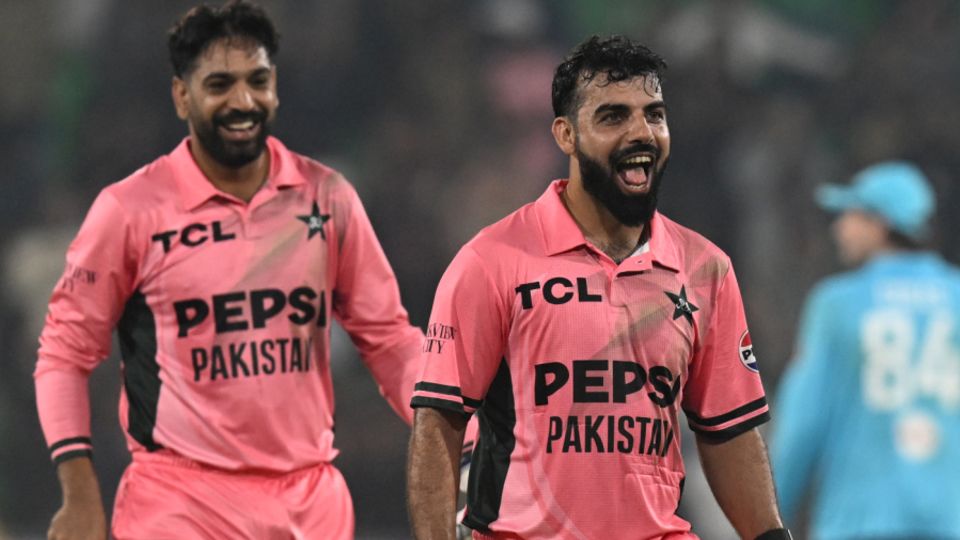
It left the two - and the thousands of cricket tragics still at the Gaddafi - stunned. Harry Brook and England had disbelieving smiles on their faces for the next couple of balls.
Shadab displayed great astuteness as he built a classic ODI innings. He worked the ball into the gaps and targeted the vacant regions - because of the field restrictions in the middle overs - to collect boundaries rather than being adventurous. He thumped debutant Henry Crocombe and Dawson for back-to-back boundaries in consecutive overs and launched Sam Curran for a gigantic six over deep fine-leg later in his innings. He even treated Atkinson with disdain, slog-sweeping him for six on the first ball as he returned for his final spell with 27 needed in the last six overs.
But it was the reversal of the lbw decision on the next ball that will go down as the defining moment of the match.
"I was more frustrated about missing the boundary because I felt I could have hit a boundary on that delivery, considering the field they had set," he reflected. "I honestly did not have any idea that I had hit the ball. And of course, I did not only miss the boundary but also ended up getting out because of which the match ended.
"There was a bit of frustration upon not crossing the line despite bringing the match close. And, of course, Haris was also frustrated, which he took out on me and compelled me to take the review."
While it is Shadab who has been getting credit for pulling off a miraculous win, none of this would have been possible without Rauf's unbeaten 19-ball 7. He was in the middle for 13.2 overs and defended resolutely to stretch the game until the end. With only 242 to chase and Shadab firing from the other end, the asking rate was never the issue.
That these two go a long way back and come from the same city, Rawalpindi, and they had been in a similar situation earlier in the year during the second ODI against Australia at this very venue meant that they were not only comfortable in each other's company but also trusted each other.
Back then, Pakistan chasing 232 on a spitting surface were eight down for 168 and the two stitched together a 21-run partnership for the ninth-wicket in a space of 42 balls. Rauf, at that time, batted for 15 balls without scoring a run.
"We were not talking about cricket at all, rather we were having fun in the middle and going with the flow," Shadab said about the latest stand. "A lot of credit for this win goes to Haris as he curbed his attacking instincts, which are usually found in the tailenders, and built a partnership.
"He had a lot of self-confidence and belief and was giving me confidence that he would not lose his wicket. We were in a similar situation against Australia here and we had put together a lengthy partnership back then so I had belief in his abilities."
The win has now guaranteed Pakistan a place in the final on Saturday. They play Sri Lanka in their last group-stage contest and would hope to stretch their perfect record in the tri-series. And all eyes will be on a rejuvenated Shadab when Pakistan take the field on Tuesday.