
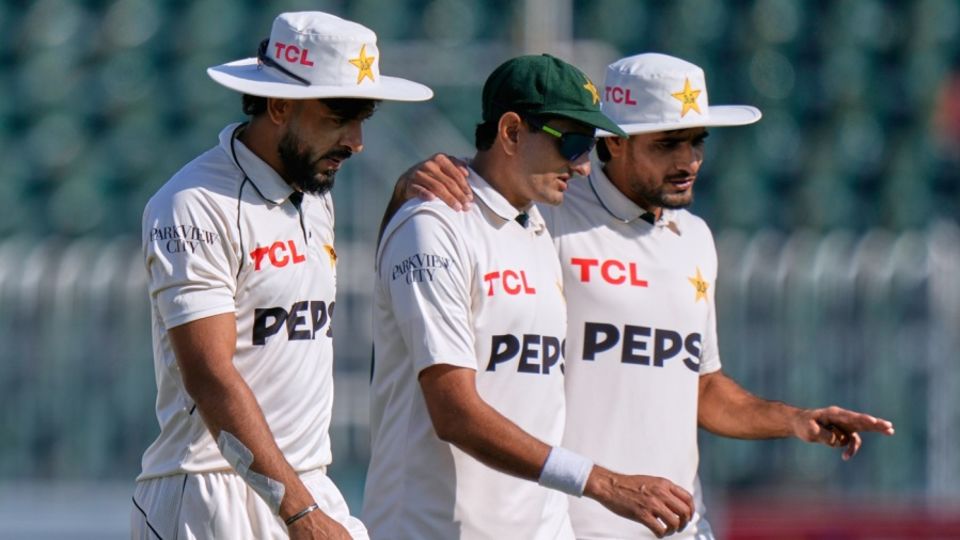



Winning a toss on a green top wicket in the subcontinent is a curious thing. A Test match strip might be prepared with five days in mind, but most captains make a decision with a view, primarily to the next two hours. If, as all external indicators suggest, the ball nips around and zips through in the early morning moisture, and with any luck, swings, bowling success in that first session may offer enough of a headstart to build a Test-winning foundation.
That is the theory, but it can sometimes look like it's built on flimsy foundations, especially in Pakistan. Those favourable conditions can evaporate into the afternoon sunshine, giving way to flat pitches and some of the best batting conditions of the game. Sri Lanka found that out to their cost in the first Test when they inserted Pakistan in, only to be pushed against the wall after the hosts came out flying.
Pakistan raced to 86 without loss inside the first 16 overs before making the most of flatter conditions later on and on the second day. Putting batters under pressure early on proved difficult; no Pakistan player was dismissed for single figures in that first innings, and six of the top eight scored at least 48. Pakistan declared after 106.2 overs of batting. A call based on the hope of winning one early session cost Sri Lanka a day and a half. Practice rarely matches theory.
Recommended Read


That is why Pakistan will look back on this morning as the special, memorable passage of play it was. For far too long over the decades, Pakistan needed only to stock up with fast bowlers, recite the incantation, and watch their Patronus charm conjure up the form they wished to see it take. They never worried about whether the ball would move enough, or if the pitch offered them enough support. The pace bowlers would hold up their end of the bargain often enough, and the rest mopped up behind them.
But trauma can change the shape of a Patronus, and Pakistan's profound shift in character means it no longer takes that recognisable form. They spent the last few years shape-shifting and self-justifying, taking their angst out on the surfaces. For a while, there was more scrutiny of the wickets than the system producing the cricketers to play on them. A few months after surgery of the personnel in the side was famously promised at the PCB, it was actually Pakistan's pitches that underwent it, literally carved open to accommodate middle-tier spinners, the very idea of nurturing quality fast bowlers falling through the cracks that lined these new strips.
Today might not have been a wholesale return to Pakistan's bona fide pace bowling heritage, but this morning was an unmistakable nod to it. There had been whispers that Pakistan might have over played their hand by having no specialist spinner in the squad, the inexperienced Arafat Minhas carrying the bulk of the spin load. Despite Pakistan's stellar first day and a half, Sri Lanka had actually come back into the match strongly, making Pakistan's quicks look at least equally toothless in return, particularly on a third day that saw just one Sri Lankan wicket fall and nearly 300 runs scored.
But instead of pulling back, Pakistan doubled down. This morning, when Babar Azam walked out with the team sheet, the solitary spinner Arafat Minhas had slipped down to the bench, with seam bowling allrounder Aamer Jamal taking his place. And when Pakistan finally won a toss - their first against Sri Lanka all tour - they bowled, eager to unleash their stock of fast bowlers with conditions at their most fertile.
This was nothing like last week, where the batters had enjoyed freedom of the city. Caged in by Mohammad Abbas and hunted by Saqib Khan, Sri Lanka lost their top three for 25. Last Test, Pakistan had brought up a 50-run opening partnership inside 53 balls. Off the 50th ball this time around, Abbas angled one into the stumps. With Sri Lanka going at less than two an over, Babar had been sufficiently emboldened to have a short leg in place, who swallowed up the bat-pad as it floated up to him.
It is perhaps a shame that so few watched what followed in the flesh. The first session, occurring as it did on a Tuesday morning, played out to nearly empty stands, and an almost equally empty media centre in Rawalpindi. The control first half hour might have been politely appreciated by the purists, but the manner in which Razaullah savaged the rest would have had the stands heaving, giving them the blood-sport Pakistan fast bowling often could be in the past. It is this city, after all, that liked a fast bowler it saw so much they called him the Rawalpindi Express. In this very stadium, there is a stand named after him.
Not a single delivery in the first two overs was bowled at under 143kph, a sharp contrast from the gentler, more subtle skills of Abbas and Saqib. But, more significantly, what he gained in pace he did not, unlike last week, sacrifice in accuracy. Just three balls across the entire innings were sprayed down leg, and only another five were wide outside off. Razaullah had found a way of being rapid without deviating from his channels, and it was a potion too strong to fend off.
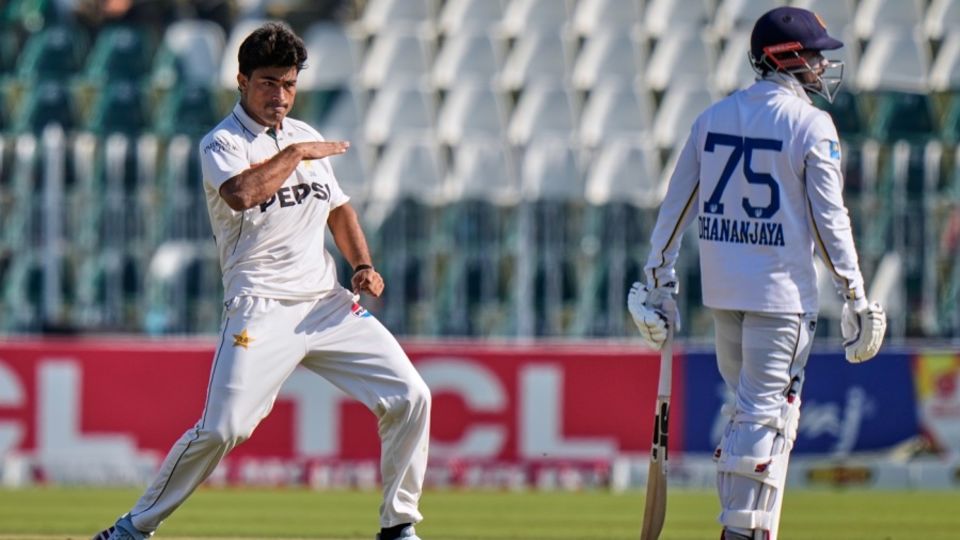
As he bore down in his third over, Lahiru Udara, who had been endlessly patient trying to see off the opening pair, scoring 4 runs in 13 overs, could not mount another resistance against this new threat. At 146kph, he was pinned deep in his crease; the thin edge flew so fast and rose so high Mohammad Taha at first slip had to reverse cup to catch it.
At that pace, there is little room to adjust for other variables. The wicket had played true in the first hour, but one Razaullah delivery skidded low. No batter would have had the time to negotiate it, and de Silva was defenceless as it thudded low into his shin, his review more a mark of protest than hope as Sri Lanka lost half their side. It was just the 18th over.
As early as this, though, there were signs of an easing pitch. A hobbling Sri Lanka limped their way through a 49-run partnership, but on a morning when Pakistan found vindication in every cranny, it was Aamer Jamal who timed his cameo to perfection, goading Mendis into a careless shot and giving Pakistan the breakthrough to round off the perfect session. Sri Lanka managed just 13 more runs, finishing with 98 - the lowest first innings Test score at this ground. They had lasted under 36 overs, and were gone by the time the sun had fully burned off the morning mist and moisture.
Perhaps every institution, shorn of former glory and denuded of fresh ideas, throws back to days of old glory, real or imagined. On mornings like these, Pakistan can perhaps treasure just how real their own former glory was, and how, even in its darkest days, what a worthwhile project attempting to keep it alive is.