
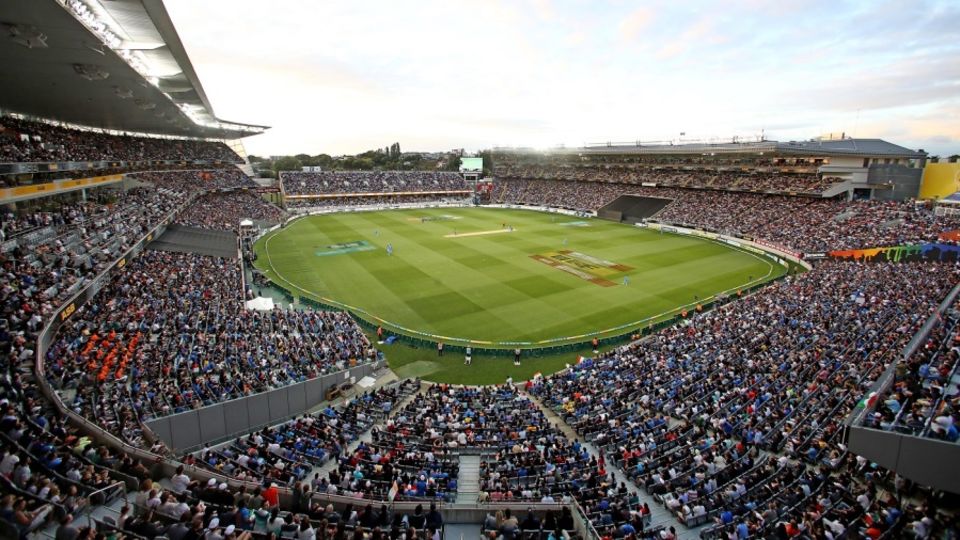


Eden Park is one of the world's great dual-sport venues, and though it was purely a cricket ground when it began life in 1903, its shape - more rectangular than oval - is perhaps better suited to its winter use as a rugby pitch. The dimensions present bowlers, batters and fielding captains challenges that occur pretty much nowhere else in the cricket world. What must the players keep in mind, then, when the venue hosts the first ODI between New Zealand and India?
It's all about the straight boundaries
According to the ICC's playing conditions for international cricket, no boundary at any ground should be shorter than 65 yards (59.43m) from the centre of the pitch for men's cricket, or shorter than 60 yards (54.86 metres) for women's cricket. Eden Park is only allowed to host international games because it was doing so long before these regulations came into effect, with the first Test match here dating back to 1930.
The shortest boundaries at Eden Park are about 52m to 55m from the centre of the pitch. Earlier, these short boundaries were in the directions of extra cover and backward square leg, but a realignment of the pitch ahead of the 2011 Rugby World Cup moved them dead straight.
Recommended Read



Matches at Eden Park since then have been defined by the straight boundaries - the batters try and hit down the ground as often as possible, and bowlers try to maintain lengths that dissuade this. India's first defeat on this tour of New Zealand came in the fourth T20I at Eden Park.
"It is definitely tempting [to target the straight boundary]," India ODI captain Shubman Gill said on Tuesday. "Especially if you are facing the spinner, if I see in my slot, if I see if it's up there [to go] on the front foot, do I want to go for it or not? But I think it's very player-specific, every player has their own plans, but for me, it's definitely very tempting, seeing the straight boundary only 50-55 meters [away]."
Cash in behind the wicket
While it's all well and good aiming straight, batters should know they are facing canny, international-quality bowlers who aren't going to let them do as they wish. Given that they won't get a lot of balls in the slot, batters will want to play length-appropriate shots and keep the scoreboard moving normally, and take calculated risks - by means of stepping out or moving around the crease - to access the short boundaries at timely junctures.
One key area to target is behind the wicket, where the boundaries are even closer to the bat than the ones down the ground. Expect to see plenty of laps, ramps, scoops and fine sweeps.

Don't pitch too short
As at most venues around the world, fast bowlers are best advised to bowl good lengths at Eden Park. In ODIs since the start of this decade, the quicks have gone at economy rates of 4.21 and 4.91 while bowling good and short-of-good lengths respectively, and at 10.66 while bowling short, according to Cricinfo's ball-by-ball data. Contrary to expectations, the short length has been even more expensive for fast bowlers than the full length, which has gone at 6.54.
Eden Park's bouncy pitch and relatively long square boundaries can tempt bowlers into going short, but if the boundaries down the ground are tiny, the ones behind the wicket are even tinier, allowing batters to score quickly with ramps and uppercuts and fine pulls and hooks if the bowling veers off line.
And perhaps even more pertinently, this is a ground where edges can fly. Of all grounds in the world that have hosted at least five ODI team innings since the start of 2020, Eden Park has the second-highest not-in-control scoring rate (4.09) behind Malahide in Dublin (4.45).
Don't discount spin
Good spinners can survive even in the most unforgiving circumstances. At Eden Park, this might mean giving up any attempt to deceive batters in flight, and going flatter and quicker and hitting the shorter side of a good length.
One other thing spinners can do is use Auckland's strong breeze to their advantage, and make batters hit into the wind, particularly square of the wicket.
Since the start of 2020, spinners have an overall ODI economy rate of 5.45 at Eden Park as compared to 5.64 for the seamers - which is impressive even when you consider that slower bowlers tend to bowl the "easier" overs. Fast bowlers, however, have been far more potent wicket-takers, averaging 25.98 to the spinners' 45.45.
Set fields wisely
Eden Park is a tricky ground for setting fields. The straight boundaries are so short that protecting them may be a waste of time in certain cases. Rather than waste fielders there, captains may choose to put the onus on their bowlers to protect those areas by not allowing batters to hit down the ground.
And because of the shape of the ground, fielders occupying neighbouring sectors of the field can be at vastly different distances from the bat. Deep backward point could be 60m from the bat, for instance, and deep third less than 50m away.
This means captains will have to work out where best to place their swiftest fielders. They will also need a keen understanding of angles, particularly when it comes to stationing fine leg and deep third. Get this wrong, and batters can simply use the pace of the ball and pick up boundaries in a rush.
"The dimensions are a bit weird, and I think it will be a challenge for us to be able to find the right placement for the fielders, if you haven't played here a lot, to be able to know which pockets exactly are the ones where balls go to a lot," Gill said. "So that will be a good challenge for us; hopefully we are able to find those pockets sooner than later."