



New Zealand captain Mitchell Santner credited visiting captain Shreyas Iyer for reading the conditions well in Mount Maunganui as India won the fifth and final ODI of the series.
The Bay Oval hosted back-to-back games, which usually slows down the pitch, Santner said, and it did offer lower pace and carry in the first innings after he opted to bowl first. That changed after sunset.
"During the day, there was a bit of spin," Santner said, "it looked quite challenging. Under lights, there's a bit more nip, bit more up-and-down bounce and less spin. I think Shreyas knew that the threat was the seamers, went all out on the seam."
Recommended Read


India had 210 to defend but that could've been a lot fewer had New Zealand not handed three lives to Axar Patel and Iyer between overs 9 and 11, after the visitors were reduced to 34 for 3.
Santner rued the misses but still backed his team to chase down the target. At 80 for 2, New Zealand were on track. Arshdeep Singh and Mohammed Siraj got Nick Kelly and Tim Seifert to open the game up. Iyer backed his pacers so much that spin was not introduced till the 36th over, with New Zealand having to play catch-up at 131 for 6. They eventually fell short by 22 runs.
"As a batting unit, if you can prolong that, there was not a lot of scoreboard pressure with 200 on the board," Santner said. "The longer you can take it, spin felt a little easier to face.
"If we could've managed to get through that phase when Siraj got brought back and Arshdeep getting poles as well, I thought we could have cashed in."
At least one team was bowled out for a sub-200 total in each of the ODIs. Santner put the batters' struggles down to early-season weather.
"Early season in New Zealand with the rain around, which leading into games probably didn't give the groundsmen a lot of time to prepare," he said. "There is a little bit in most wickets [in New Zealand] usually this time of the year.
"200 on most grounds might have been a good score. So I think it was a very close series and the bowling groups in both camps did really well. Great use of the short ball throughout the series."
New Zealand lost the ODI series 3-1, their first loss in home bilaterals since 2019, and the T20I series 3-2. The scoreline, according to Santner, belied the level of competition.
He viewed New Zealand getting bundled out for 134 in the second ODI, and letting the game slip away in the second T20I, where India recovered from 70 for 5 to chase down 181, as what-if situations.
"It's easy to look at the scoreline, it's obviously a lost series, and I think it was a very close series, it could've gone either way," Santner said. "We should've got more than 130-odd in Wellington, maybe defended that; we should've chased that down here.
"Even looking back at the T20Is, we definitely let one slip in Christchurch. It could've been a 3-2 [in our favour], so it's been a very competitive white-ball series across nine games."
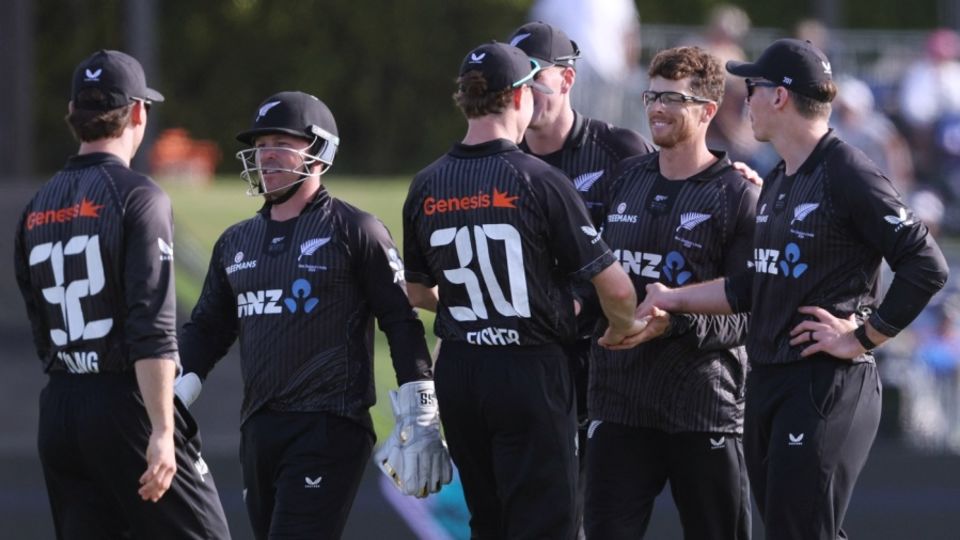
On the plus side, the short turnarounds allowed both teams to try out new players. Santner was pleased with the progress of Matt Fisher, Blair Tickner and Jacob Duffy. With the bat, Will Young boosted his chances of making to the World Cup squad with a ton in the fourth ODI.
"You look at a lost series, it's the first time we've lost in a while in New Zealand," Santner said. "But plenty of good to come out of the series. World Cup year, you want to see depth in our bowling stock and it's been really good, whether it's through rotation or forced through injury. Matt Fisher showed his pace, Ticks and Duff are there and thereabouts.
"Batters are coming in, Willy Young scoring a very well-timed hundred. Now we have to shift on pretty quickly to the Tests."