
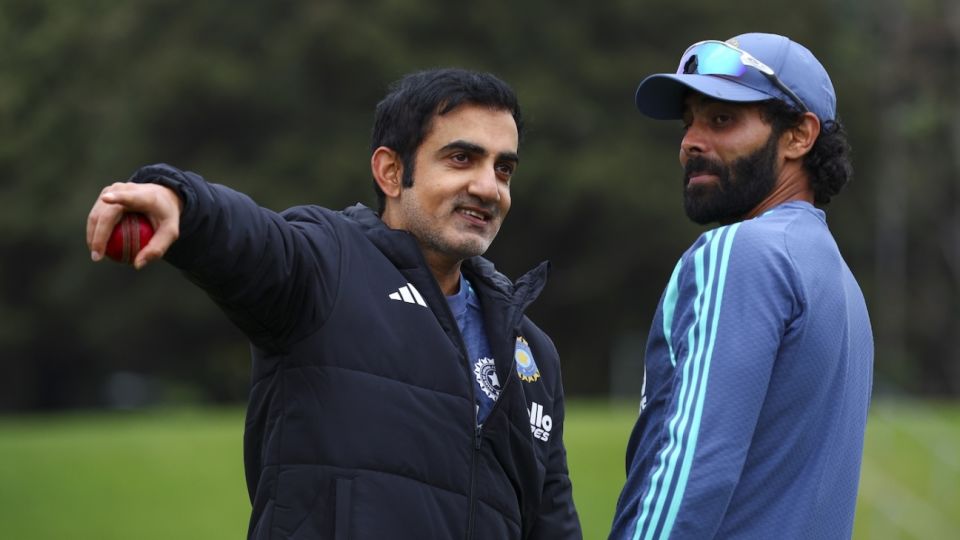




Four days after dominating the first Test in Wellington but coming away with just a draw, India begin the second Test against New Zealand in Christchurch with the series still 0-0 and a lot of tired legs in their bowling attack. They sent down 241 overs at Basin Reserve and have not had a whole lot of time to recuperate. Will India stick to the same attack at Hagley Oval, or will they ring in the changes? And if they do, who comes in, and who goes out?
What have India done since the Wellington Test?
India travelled to Christchurch on Tuesday, and chose not to train on Wednesday, with their bowlers having endured a heavy workload in the first Test in Wellington. They were due to go through a full training session on Thursday, but heavy rain through the first half of the day threw a spanner in the works.
When the players finally made it to the outdoor nets - after the batters had faced throwdowns indoors - only four of the quicks did any bowling. These were Mohammed Siraj and Gurnoor Brar from the Test squad, and Arshdeep Singh and Auqib Nabi, who are travelling with the team as net bowlers.
Is there a chance of a Siraj comeback?
Typically, the fast bowlers who are expected to play a Test match don't bowl on the eve of the game. And given the workloads that Jasprit Bumrah, Anshul Kamboj, Akash Deep and Prasidh Krishna got through at Basin Reserve - all of them bowled 40-plus overs on an unforgiving surface - it made perfect sense that none of them bowled during the gap between the Tests.
In his post-match press conference in Wellington, India captain Shubman Gill said Siraj had been left out because the team management felt the other bowlers had been in better form than him. And given how India have handled Siraj on this tour - they didn't play him in the ODI series until the fifth and final match, and kept him on with the ODI squad after the third ODI when they released Gill, KL Rahul and Kamboj to join the preparatory camp for the Tests - it's hard to say if they have given him the best chance of getting back into his best rhythm.
Given that his experience and record of winning Tests for India outside Asia didn't sway the team management into playing Siraj in Wellington, it seems unlikely that those factors will come into the picture in Christchurch. But one thing they might consider is his ability to trouble left-hand batters. New Zealand's top four is entirely made up of those.
Will there be a debut for Gurnoor Brar?
Much like the pitch at Basin Reserve on the eve of that Test match, the pitch at Hagley Oval on the eve of this looked lush green. Appearances, though, can be deceptive, and both teams are holding their breaths and hoping that this pitch doesn't flatten out quite as much as that one did.
Both teams are hoping, most of all, that there is bounce and carry on this pitch, which would mean the fast bowlers have something to work with even if seam movement dies out after day one or two.
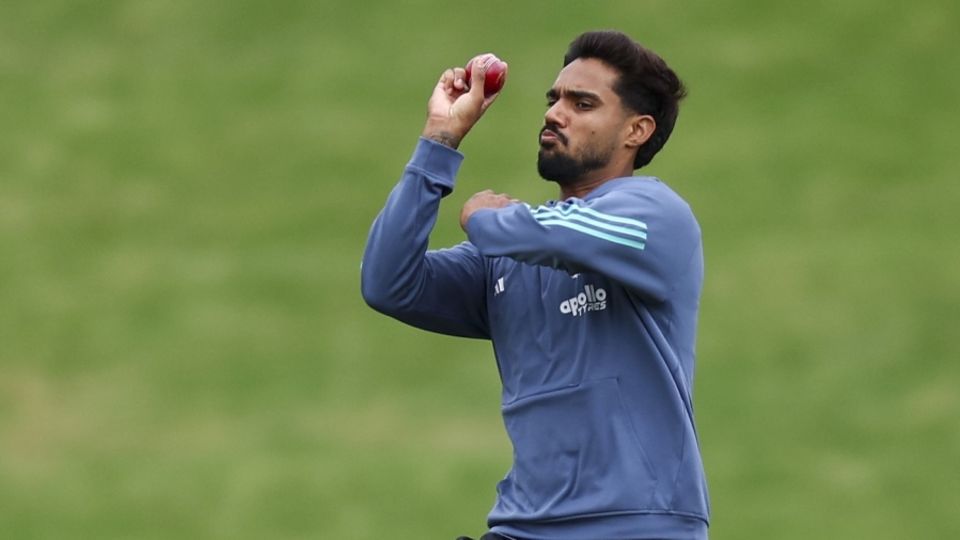
There is still a chance that Christchurch could play out similarly to Wellington, however, and if India feel there is a strong enough chance, they might seriously consider giving Brar a Test debut.
The one thing Brar has over the other seamers in India's squad is raw pace. He's a tall, hit-the-deck bowler like Prasidh, but can operate within a higher pace bracket, around the 145kph mark. He was parachuted into the Test squad on the basis of a Player-of-the-Series performance in the ODIs, and if India sense that the Christchurch pitch might slow down over time like the one in Wellington did, they might feel the need for his extra pace in their attack.
The question of batting depth
One thing that might stand in the way of either Siraj or Brar getting a game is their batting ability - or lack thereof. Right through Gautam Gambhir's tenure as head coach, India have shown a reluctance to play a No. 8 without a solid ability to contribute runs down the order. In that sense, it was quite a departure for this team management to have not played the allrounder Nitish Kumar Reddy at No. 8 in Wellington and play four genuine fast bowlers.
Recommended Read


That quartet, however, included Kamboj and Akash Deep, who can be viewed as offering enough batting ability as a pair to offset the absence of Reddy.
For Siraj to play, India will need to leave out one of Kamboj and Akash Deep, given that the three of them bowl in a broadly similar manner. Bumrah is a one-off, and irreplaceable unless there are fitness concerns, while Prasidh is taller and can be used as a hard-length enforcer to try and extract something out of a pitch that's going flat.
Given the batting insurance Kamboj and Akash Deep offer, India might find it difficult to include Siraj even if they think his bowling is back to its best.
Brar for Prasidh is a possibility, though it seems unlikely given that Prasidh showed his value during New Zealand's second innings in Wellington, taking the wickets of Henry Nicholls and Rachin Ravindra with the awkward bounce he gets.
The one thing Brar might do better than Prasidh, however, is executing an all-out short-ball plan. Prasidh tried this in New Zealand's first innings in Wellington, and numerous times in England last year as well, usually with little success. Over his short career so far, he has looked at his most dangerous while bowling his normal lengths, and discomfiting batters with his natural gift of bounce, and a bit of seam movement.
Washington vs Jadeja
The overwhelming left-handedness of New Zealand's top four prompted India to leave out one of their greatest-ever Test cricketers, Ravindra Jadeja, and play Washington Sundar as their spin allrounder.
Washington bowled impressively at Basin Reserve, sending down 20 tidy overs in the first innings, 35 in the second, and using the wind to generate impressive amounts of drift. This was key to his dismissal of Devon Conway in the second innings.
That, however, was Washington's only wicket of the Test. Now, it's hard to fault him for not presenting a more outright wicket threat on such a placid pitch, but while watching that match progress, India may have wondered about the thinking that prompted them to play him ahead of Jadeja.
It usually makes sense to pick an offspinner rather than a left-arm spinner against a predominantly left-handed line-up. But on pitches with little turn in them from a stump-to-stump line, the one area that spinners can use are the footmarks outside off stump that develop over time. With right-arm over being the predominant angle of attack in most matches, the areas that end up with the most footmarks are invariably located outside the left-hand batters' off stump. And typically, they end up too wide of off stump for the ball turning away to be much of a threat.
This, perhaps, is where Jadeja might score over Washington - as a potentially bigger second-innings threat to left-hand batters.