


If you're Rachin Ravindra, and if you've been out twice flashing at good-length balls in the corridor in your previous Test match, you kind of know what you're going to get the next time you bat. And so it was on day one at Hagley Oval.
Ravindra had faced eight balls, all of them from Akash Deep, and he had left five of them alone, including the last three.
India had just taken two wickets in the space of five balls without conceding a run, and they had continued bowling dots thereafter - ten more in a row, from Anshul Kamboj and Akash Deep.
Recommended Read


New Zealand had gone from 110 for 1 to 110 for 2 to 110 for 3, and they were still 110 for 3.
It felt as if Akash Deep could continue to pound a good length and keep the ball on a fifth- or sixth-stump line and keep asking Ravindra, a man carrying considerable baggage from his dismissals at Basin Reserve, how long he could keep leaving the ball, and how long he was happy to let the scoreboard stagnate.
Then, with the last ball of that over, Akash Deep changed tack.
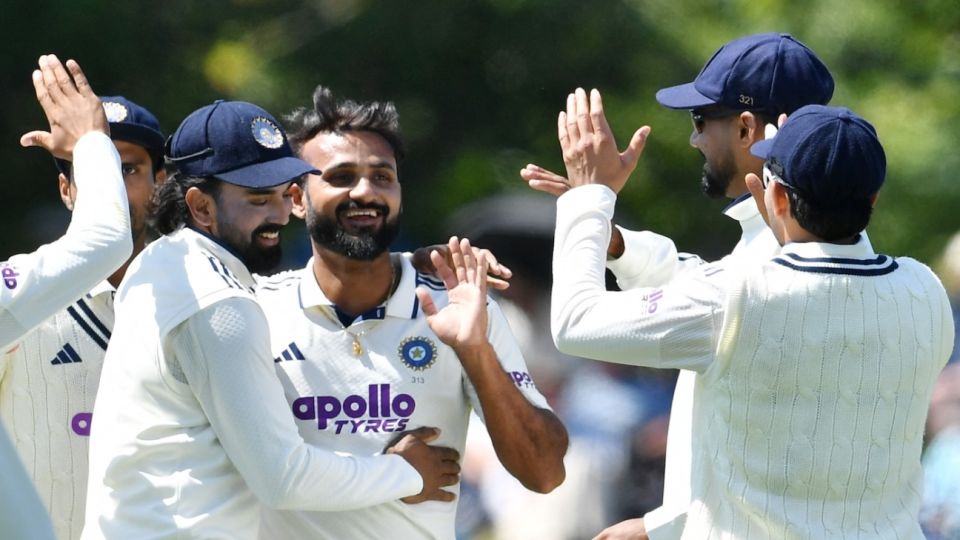
Staying around the wicket, Akash Deep delivered this ball from the very edge of the crease, creating an acute angle into off stump. Ravindra, trying to get on the front foot but mostly just stuck on the crease, felt tentatively for the ball, and it straightened, kissed his edge, and disappeared into the gloves of a tumbling Rishabh Pant.
This ball would have forced anyone to play, not just someone so starved of the feeling of bat on ball. Akash Deep had delivered a near-identical ball to Tom Latham, one of the world's foremost leavers of the ball, and produced a near-identical dismissal to begin the slide from 110 for 1. But everything that preceded Ravindra's dismissal - the events of the first Test, the events of the eight preceding balls - made it even more satisfying to witness.
And both dismissals were classic Akash Deep.
Akash Deep is an interesting bowler. He isn't short, but he isn't tall either, by fast-bowler standards, and he gives the appearance of skiddiness. But balls that skid typically don't lose a lot of pace off the pitch and tend to bounce slightly less than expected. Akash Deep isn't skiddy in that sense.
He has a high release point that belies his height - during last year's tour of England, he was measured to have a release point only 1.3cm lower than that of the significantly taller Prasidh Krishna - and from there he hits the pitch with high vertical velocity. The analyst Himanish Ganjoo, who was part of India's backroom during Rahul Dravid's tenure as head coach, noted before the 2024-25 tour of Australia that Akash Deep's combination of high vertical velocity and persistent length made him one of the most exciting fast-bowling packages in Indian cricket.
High vertical velocity and the ability to seam the ball are crucial in Aus. High vertical velocity means the ball falls harder into the pitch, generating not only more bounce but also more seam movement.
— Himanish Ganjoo (@himganj153) September 24, 2024
The appearance of skiddiness comes from two things. One, Akash Deep has a delayed arm action, which gives him an extra yard of pace that can surprise batters, and two, the vertical velocity helps him extract higher-than-average seam movement and uneven bounce from a given spot on a pitch. Batters often have to adjust to something or the other when they face him, and end up looking hurried.
After lunch on Friday, all of Akash Deep's attributes came together irresistibly in a spell that eventually read 7-5-7-2.
Akash Deep has bowled this kind of spell numerous times already in his Test career, but they haven't usually produced bursts of wickets, apart from his new-ball spell on debut in Ranchi in 2024, and his match haul of 10 for 187 in Birmingham last year. He's often bowled spells full of deliveries that have beaten the bat but not found the edge. In the first innings of the 2024 Gabba Test, for instance, he took just one wicket despite inducing 53 false shots.
Of the four fast bowlers who have played most regularly for India since his debut, Akash Deep has induced false shots more frequently than anyone other than Jasprit Bumrah. But he has the highest false-shots-to-wickets ratio of the four.
Friday at Hagley Oval was, in that sense, typical of Akash Deep's career. He induced more false shots than any other India fast bowler - 34, with Bumrah and Gurnoor Brar in joint-second with 26 each - and only ended up with two wickets, on a pitch where the ball nipped around constantly and sometimes bounced disconcertingly. He beat the bat numerous times, had a catch dropped in the slips, and watched an edge fly through a gap in the cordon.
And while Akash Deep has been unlucky before, this was one of those times when he wasn't alone, with Bumrah and Brar also enduring similar fates. Eventually, New Zealand recovered from their post-lunch slump and might even have ended the day the happier of the two sides, at 246 for 5.
But India will know they are one wicket away from the lower order when they return with fresher legs on day two, with a ball that is less than five overs old. Their luck could yet turn.
And beyond this match and this series, they will be thrilled with the way Akash Deep has bowled. Having been out of action for nearly eight months with a stress fracture of the back, he only returned to competitive cricket at the start of October.
But he's looked sharp right through this series, sending down 43 overs in unforgiving conditions in Wellington and coming back four days later to bowl 21 on day one in Christchurch. He has kept coming back with little loss of intensity for spell after spell, attacking batters in that familiar, interrogative way. It's felt like he never went away at all.