


Test matches (2): New Zealand 0, West Indies 0
One-day internationals (5): New Zealand 2, West Indies 1
Twenty20 internationals (2): New Zealand 1, West Indies 1
One-day internationals (5): New Zealand 2, West Indies 1
Twenty20 internationals (2): New Zealand 1, West Indies 1
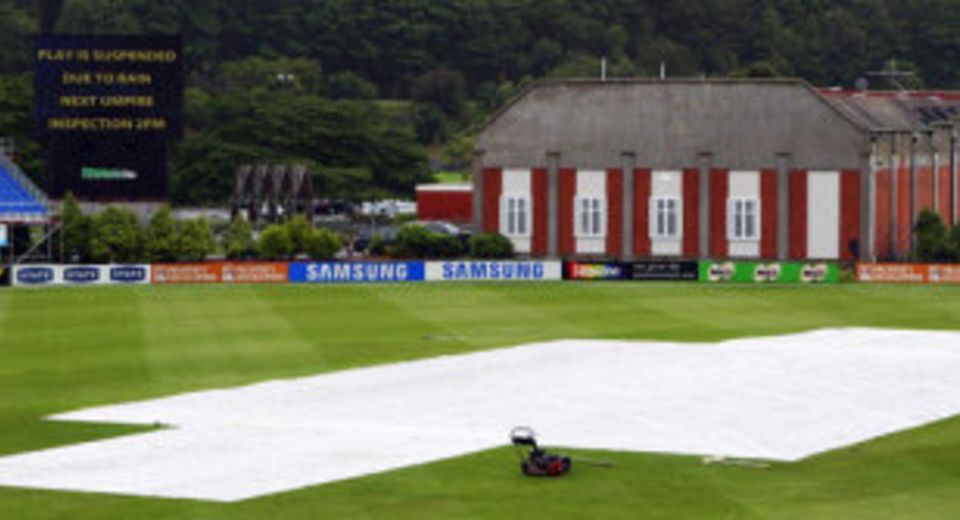
While Australia and South Africa, the current heavyweights of world cricket,
were slugging it out across the Tasman in a pulsating contest in front of
large crowds, New Zealand and West Indies were engaged in a flyweight
bout reduced almost to futility by weather more suitable for the All Blacks
than the Black Caps.
The first of the two Tests was cut in half by rain and a soggy outfield at
the University Oval in chilly Dunedin. There was not enough play for a
decision in two of the five one-day internationals, and two of the others
were decided by the artificiality of the Duckworth/Lewis method. The only
matches completed without a contrived result were the drawn Second Test
- an even scrap throughout until New Zealand called off their spirited pursuit
of 312 in 60 overs - the third one-day international, comfortably won by
New Zealand, and the two Twenty20 games. These produced one win apiece,
the first to West Indies by the new tie-breaker of an eliminator, soon
christened the "super over", instead of the bowl-out by which New Zealand
had triumphed after the first such match between the teams, also at Auckland,
had ended in a tie in 2005-06.
As significant as the cricket itself was the reaction to the experimental
umpires' review system. This was being trialled in Tests for the second time,
after its introduction in Sri Lanka's home series against India five months
before. The consensus among players - those on the field and the old ones
in the commentary boxes - was that the system was here to stay, but the
limit of three unsuccessful challenges should be reduced to one.
After the weather-induced stalemate in the series, West Indies remained
seventh in the ICC Test rankings with New Zealand narrowly behind. In the
one-day rankings New Zealand remained fifth and West Indies stayed eighth.
Both sides set out against troubled backgrounds. Following unconvincing
performances in England and Bangladesh, New Zealand had been soundly
trounced in two Tests in Australia, moving their former captain Martin Crowe
to call it "our worst moment in Test cricket". The preceding five years had
been "probably the most destructive to our game in the history of our game",
he charged. West Indies, on the other hand, had not won an away series,
other than in Bangladesh or Zimbabwe, since beating New Zealand in 1994-
95, and they arrived with 13 defeats, and only two wins, in their 16 oneday
internationals against Test opposition in 2008.
In the circumstances New Zealand, under a new coach, the former
Warwickshire batsman Andy Moles, gained more satisfaction from the
outcome. Newcomers Tim McIntosh, left-handed, and Martin Guptill, right,
eased the long-standing problem at the top of the order with impressive
hundreds, McIntosh in his second Test, Guptill in his first one-day
international. Moles's decision to swap Daniel Flynn and Jesse Ryder in the
batting order in the Tests was also an instant success.
Recommended Read


If Daniel Vettori's left-arm spin was predictably the hub around which
the bowling revolved, Iain O'Brien maintained the seam-bowling progress
he had made in England and Australia while, in a rare Test appearance,
Jeetan Patel secured his first five-for at Napier.
With their dismal recent history it was, on paper, a welcome change for
West Indies to have kept a clean sheet in the Tests and come within an over
of clinching the one-day series; in reality, it was another disappointing
campaign. Not one of the young players making their first tour advanced.
As Ramnaresh Sarwan, who quit the vice-captaincy on arrival, batted like
a man with more on his mind than runs, they relied almost exclusively on
their two most experienced players, captain Chris Gayle and Shivnarine
Chanderpaul. Once they were out, a collapse was never far away. Gayle was
in the form of his life. His 197 in the Second Test and 135 in the fifth onedayer
- both at Napier - were masterpieces; his 23 sixes and average of 70
in all matches were a measure of his dominance. Chanderpaul was the same
prolific, immovable barnacle of the previous two years.
The left-hander Brendan Nash, born in Australia and appearing for West
Indies two years after returning to the land of his Jamaican parents,
demonstrated the value of an upbringing in the tough environment of state
cricket for Queensland in two vital partnerships with Chanderpaul and Gayle
in the Second Test. Meanwhile, Jerome Taylor's maiden Test hundred, at
Dunedin, supported the general view that he had the makings of a genuine
all-rounder. Fidel Edwards, who passed 100 wickets during his Test-best
seven for 87 at Napier, spearheaded a pacy but inconsistent attack frequently
let down by faulty catching.
There was also evidence of the indiscipline that has been one of the causes
of West Indies' decline. Daren Powell charged through the crease during the
Napier Test and deliberately threw the ball past Brendon McCullum, the
feisty New Zealander. There was no sanction from either the team
management or the match referee, Javagal Srinath, but there was when Kieron
Pollard smashed a pane of glass in the dressing-room after he was out to a
poor decision in the Wellington one-day international.