
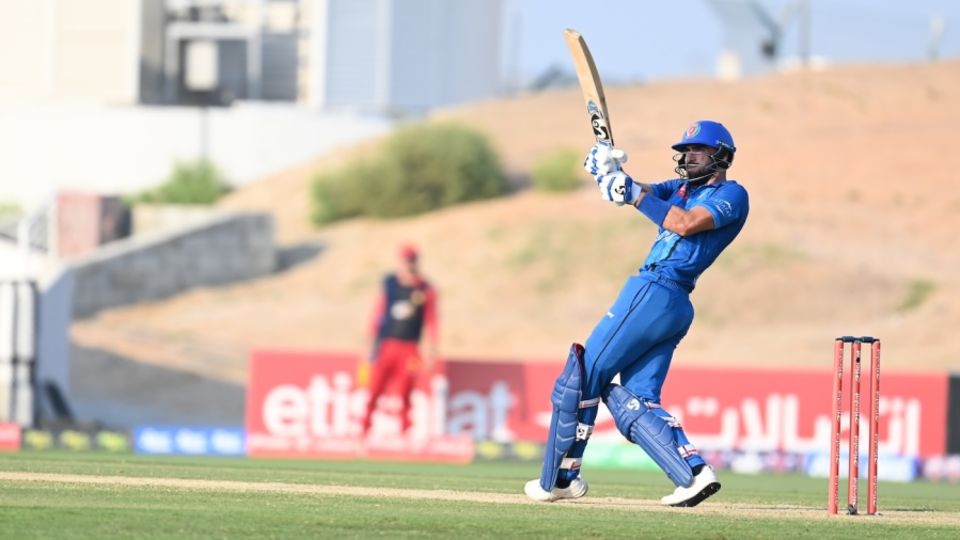


Ibrahim Zadran was sitting in the dugout with a plastic bottle in his hand, swinging it across the line. He was shadow-batting the shot that had brought about his dismissal against Zimbabwe: a pull played too early off a short ball from Brad Evans.
Only a handful of fans had trickled into the stands, with the high humidity making it feel close to 40 degrees Celsius. With Sediqullah Atal for company through most of his innings, Zadran's Afghanistan jersey had turned two shades darker, drenched in sweat. Yet, while he was batting, he could hardly have looked more at ease.
His dismissal rounded off a curious sequence. His previous two ODI innings in Abu Dhabi had ended on 95 and 95. On Monday afternoon, he fell for 90. It was his fourth dismissal in the nineties, to go with three in the eighties. For much of the innings, the opener had looked set for his eighth ODI century. By the end of the evening, the story was why he hadn't got there.
Recommended Read

This was a game played on an old-fashioned ODI pitch - slow and grippy - in the second match of an old-fashioned ODI tri-series. Zimbabwe's misfields and missed chances were compounded by the intense heat. At one point in the 29th over, Sikandar Raza let out an uncharacteristic cry of anguish when Blessing Muzarabani misfielded. Atal was on 53 off 66 balls, struggling to hit through the line as he prefers to.
At the other end, Zadran had somehow been ambling along. He was on 83 off 85. Speaking to the broadcasters after the innings about what would become a 140-run second-wicket partnership with Atal, he said: "We have enjoyed ourselves. We were just communicating to target two-three overs. Don't overthink, or go too forward."
Simple as that for Zadran. Except, his ease at the crease masked considerable technical prowess.
A telling graphic appeared on the broadcast shortly after Zadran crossed 50. It showed three stills of him driving, each capturing the moment of impact with the ball. In the first, his centre of gravity was forward; in the second, it was centred; and in the third, it had shifted back. In all three, he met the ball under his eyes, driving with a high elbow.
Zadran's most productive shot of the innings was the on-drive. He scored 32 runs - more than a third of his total - towards deep midwicket. His control percentage on this sluggish pitch was 88%, built on the technical precision with which he adjusted his position and timing to meet the ball, despite the variable pace and bounce.
"We were just trying to get 300-plus," Zadran said after the game. Afghanistan fell just short, finishing on 294, though for a while, with him and Atal at the crease, they had looked set for considerably more.
Despite their contrasting approaches, the pair have been prolific together, scoring 693 runs in nine innings at an average of 77. Zadran said he and Atal had been batting together in the nets and working through match scenarios.
"We just try to bring that skill into the game," Zadran said. "People used to say that I have a good understanding with [Rahmanullah] Gurbaz, but nowadays I build brilliant partnerships with Sediqullah Atal."
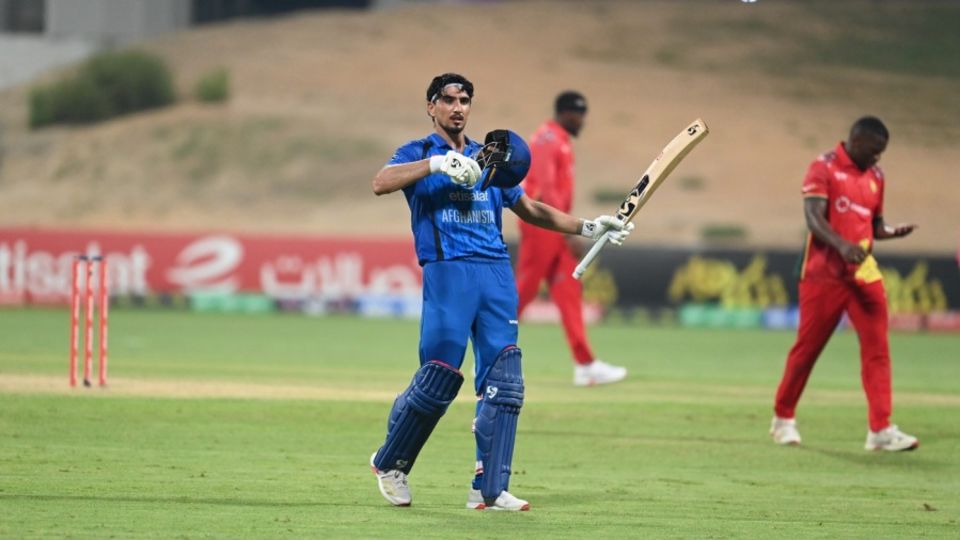
Of the two, it was Atal who brought up his century - 102 off 110 balls - relying on his preferred cross-batted slogs to relieve the pressure of dot balls. Unlike Zadran, he struggled to counter the slower deliveries by playing through the line. His was consequently the riskier innings, with at least four aerial shots flying just beyond Zimbabwe's fielders before a fifth finally found long-on in the death overs.
Though their numbers looked similar by the time Atal was dismissed, Zadran's USP in this side was clear to anyone watching: his runs came with greater assurance and less risk.
He did swat two sixes, including a high-elbowed jab over cow corner off Raza in the 13th over. But that came off a free hit. The other was relatively low-risk too, as he cleared his front leg to dispatch a Wessly Madhevere half-tracker.
Against a more proficient batting side, Zadran's dismissal could have proved costly. Seven of the eight batters who followed him finished in single digits as Afghanistan slowed down in the death overs.
After 47 ODI innings, Zadran now averages exactly 50. His low-risk batting template is well suited to the UAE pitches, but he has scored his runs at a lower gear than most modern top-order batters. His ODI strike rate stands at 82.42.
That is what made his dismissal particularly telling. It came when he strayed from his natural tempo, trying to force the pace. In the 32nd over, he misread the trajectory of Evans' short ball, lost his usually compact shape and mistimed the pull to a fielder on the leg-side boundary.
During the India series in October, on pristine tracks that Afghanistan head coach Richard Pybus described as "a sheet of glass", Zadran had failed to cross 40 in three attempts, albeit in T20Is. Pybus attributed Afghanistan's slower scoring rate to their inability to hit "off the top of the length" of deliveries. Zadran's proficiency in the 'V' - playing close to his body and staying compact at the crease - is almost the antithesis of proactively meeting the ball early and hitting off the top of a length.
At the same time, Zadran has shown how high his ceiling can be once he is set. His 146-ball 177 against England in the 2025 Champions Trophy, the highlight of his ODI career, demonstrated that he could stick to his strengths and a conventional range of shots while still accelerating when he needed to.
That innings, though, remains an outlier in his career so far. Missing another hundred is unlikely to bother Zadran as much as his inability, once again, to weigh up the risks and accelerate towards the back-end of an innings. The fact that this happened as he approached a milestone was almost incidental.
"Yes, people get hurt when they miss hundreds, but I don't worry about it," he said. "I [was] thinking to play a very positive game [at] that time because sometimes the situation gets changed. If you think about the milestone, then you can't focus on the team and you can't focus on the scoreboard."
Zadran was Afghanistan's most assured batter on the day, but he knew he had to be more positive for the sake of the team's total. For now, he will have to keep working on his finishing game. He might make batting look easy, but sitting in the dugout, miming his dismissal with a plastic bottle, he would have known it is anything but.