
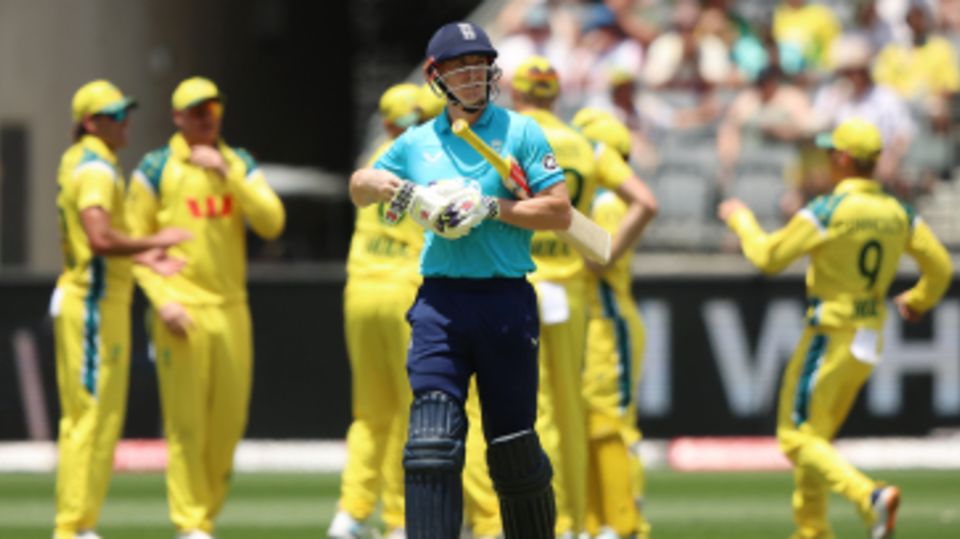


England will attempt to use Sunday's second ODI in Adelaide as a dry-run for the tight turnarounds they will experience at next year's World Cup after they were blown away in Perth for the second year in a row.
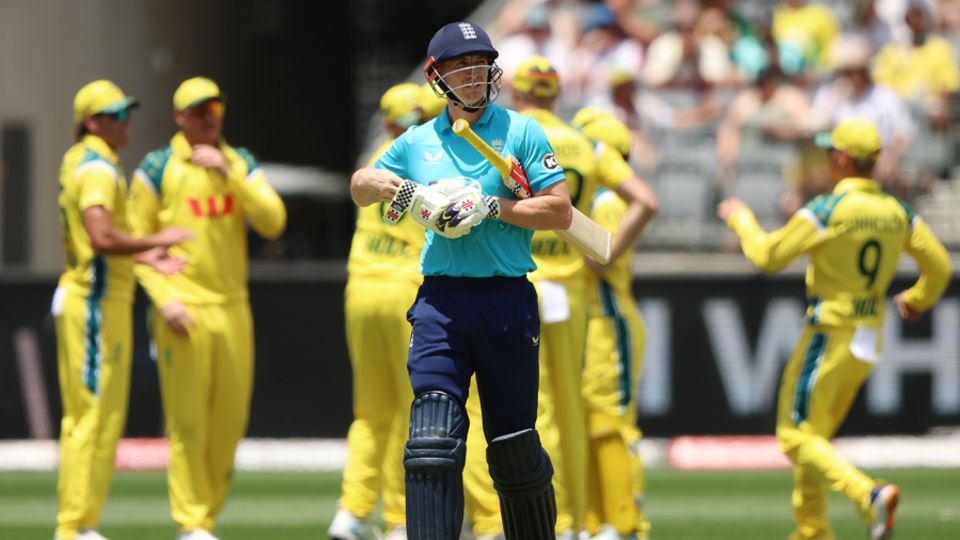
England were bowled out for 172 and 164 as they lost last year's opening Ashes Test by eight wickets inside two days, and managed a paltry 131 on their return to the Optus Stadium just under a year on. Even that total represented something of a recovery, after debutant fast bowler Mahli Beardman had reduced them to 65 for 8 after 19 overs.
Harry Brook, England's captain, acknowledged that his side were unable to blame preparation this time either: after a farcical build-up to last year's Ashes series at a club ground, England tuned up for this three-match ODI series with an intense training block which included a rare white-ball warm-up match against Western Australia at the WACA.
Instead, Brook and head coach Brendon McCullum said that England had simply been outplayed, and that they had failed to put their plans to cope with a notoriously bouncy pitch into place. "It's another experience that we can look back on and hopefully it'll help us in the future," Brook said, after Australia had completed their seven-wicket win.
"It's disappointing, always, to lose," he added. "We can't blame the preparation at all. I think we've had a really good week-and-a-half training in these conditions as well. We probably didn't execute as well as we could have done. But the Australian attack, they put the ball in the right areas for a long period of time and asked us a lot of questions."
There is a very tight turnaround to Sunday's second ODI at Adelaide Oval, with England only due to land on Australia's east coast at 9.30pm on Saturday night after a three-hour flight. It means they will not have the chance to train between games or acclimatise to a very different venue, with much shorter square boundaries and, typically, lower bounce than in Perth.
While the gap between matches is unusually short given the travel involved, McCullum said that England would have to get used to it ahead of next year's World Cup. If they qualify for the 'Super Seven' stage, England will play six matches in a 15-day period from October 27 to November 11, with two-day gaps between each fixture including some long travel days.
"If you look at the World Cup, there's potentially 13 games [if England reach the final] played in three different countries, and there's a lot of travel," McCullum told TNT Sports. "There's some games played at altitude, other games at sea level, and it's a really quick and demanding schedule for you to go all the way, so you need to be supremely fit.
"One-day cricket is incredibly taxing on the body if you get games which go the distance and then you've got to back up time and time again, and we've got a live example of that in two days' time, where we get into Adelaide tomorrow night about 9.30pm and then we play the following day. We have got some live challenges in front of us which will hopefully set us up a little bit, experience-wise, for the World Cup.
"For us, being fit is definitely going to be a key attribute, but more than anything, it's being able to adapt to the conditions as quickly as you possibly can. We obviously didn't do it today and we'll talk about that, and try to come up with some ways to ensure that if we find ourselves in a situation like that again, we can scrap a bit deeper in the game to give ourselves a decent chance."
Brook took a similar angle, saying: "We've got to adapt to conditions as quickly as possible [in Adelaide]. We're not going to have a training session; we've got a flight tomorrow and then we're pretty much straight into the game. But that replicates what the World Cup's going to show us… It's a good opportunity for us to learn some lessons."

England left Adil Rashid out of their side once again, with Liam Dawson preferred for the fourth ODI in a row. The decision made minimal impact on the result, and England's captain and coach defended both England's choice of spinner and the balance of their side - specifically, picking four allrounders in Sam Curran, Will Jacks, Dawson and Jamie Overton from No. 6-9.
"We knew that the surface here today was going to be seam-friendly and spin wasn't going to play a massive part, hence why we went with Daws [who is] probably a better batter than Rash at the minute," Brook said. "That was the right decision in the end. Obviously we haven't got the result that we wanted and Daws didn't bowl, but we knew it was going to be seamer-dominant."
McCullum added that the broad range of likely conditions at the World Cup had informed England's allrounder-heavy strategy. "You need a variety of players within your squad," he said. "Keep in mind you're only allowed to carry a squad of 15, so you need some multi-skilled players to be able to pivot in-game if the conditions do slightly change to what everyone expects."